US President Donald Trump has issued a stark warning to Hamas, threatening to “disarm them violently” if the militant group fails to surrender its weapons within what he called a “reasonable period of time.” The warning comes amid a wave of deadly violence in Gaza, where Hamas is reasserting its control through public executions and harsh crackdowns on those it labels “collaborators.”
Speaking to reporters on Tuesday, Trump made it clear that Washington would not tolerate Hamas’s continued militarization. “If Hamas doesn’t disarm, we will disarm them,” he said, without offering a precise timeline. His statement comes as Gaza reels from scenes of lawlessness and brutality, which have surfaced online since the US-brokered ceasefire took effect last week.
Hamas Executes ‘Collaborators’ in Public Display of Power
Verified footage circulating on social media shows Hamas fighters executing unarmed men in Gaza City’s Zeitoun neighborhood — a site recently under heavy Israeli assault before being retaken by Hamas. The videos, authenticated by BBC Verify, reveal masked fighters forcing a group of eight men to their knees before opening fire in front of a crowd that included civilians and children.
Crowds were heard shouting “collaborator” and “agent” moments before the execution. After firing, the fighters raised their rifles and chanted, “Long live the al-Qassam Brigades,” Hamas’s military wing.
Another video showed a separate incident where armed Hamas men shot a man in the leg, leaving him bleeding on the street while others fired in the air to disperse onlookers. These scenes, according to rights observers, are part of Hamas’s effort to crush rival clans and restore its grip on Gaza following months of internal disorder.
Chaos and Fear in the Streets of Gaza
The executions have sent shockwaves across Gaza, reigniting fears of a return to pre-war authoritarian tactics. “Why are people cheering for chaos?” one Gaza-based lawyer told the BBC. “A masked man kills another masked man without proof, without investigation, without a court. What do we call this — resistance? No, this is lawlessness.”
Another activist echoed the same frustration: “Executions without fair trial are a crime. You can’t correct one mistake with another.”
Analysts note that Hamas’s recent show of force — which includes armed patrols, roadblocks, and widespread arrests — is a calculated move to intimidate both internal rivals and potential defectors.
Trump’s Threat and Washington’s Balancing Act
Trump’s comments mark a sharp escalation in US rhetoric since the fragile truce began. Despite overseeing the ceasefire, Washington now finds itself grappling with how to respond to Hamas’s violent enforcement campaign while maintaining regional stability.
Asked about the internal clampdowns, Trump appeared to defend Hamas’s right to maintain order — within limits. “They do want to stop the problems, and we gave them approval for a period of time,” he said. “You’ve got close to two million people returning to demolished buildings. We want it to be safe.”
However, his later remarks — threatening violent disarmament — signal a possible hardline pivot that could test both US credibility and the ceasefire’s endurance.
The Clan Conflict and Israel’s Shadow Role
The recent executions also tie into long-standing tensions between Hamas and Gaza’s powerful clan networks, including the Dughmush clan — a family historically involved in smuggling operations across the Israeli border. Recent clashes between Dughmush fighters and Hamas left more than 50 people dead, including 12 Hamas members.
Analysts told BBC Verify that some of these clans, particularly in Gaza’s south and north, have received arms and financial support from Israel over the years to weaken Hamas’s control. “At least some of the clans have been reported to receive weapons and other support from the Israel Defense Forces to act as proxies against Hamas,” said Dr. Yaniv Voller, a Middle East politics lecturer at the University of Kent.
This tangled web of rivalries has allowed external powers to exploit divisions within Gaza — a dynamic that now threatens to reignite open warfare among competing militias.
Hamas’s Internal Security Forces Reemerge
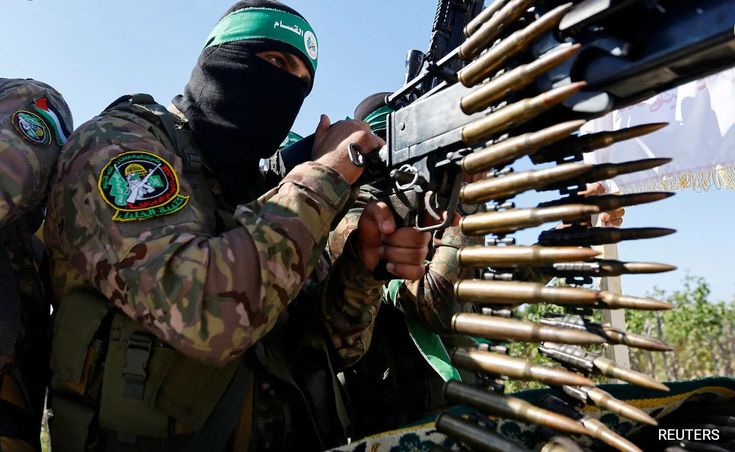
In recent days, Hamas has deployed heavily armed internal security units across Gaza City. Fighters carrying assault rifles and wearing insignia of Hamas’s interior ministry have been photographed patrolling marketplaces and intersections.
According to Professor Fawaz Gerges of the London School of Economics, this militarized show of force reflects Hamas’s determination to reassert dominance. “In the areas it still controls, Hamas will destroy the various clans and militias,” he explained. “Its fighters are more disciplined, more experienced, and more determined.”
Still, Gerges warned that such heavy-handed tactics risk deepening the humanitarian crisis and alienating ordinary Gazans already exhausted by war.
Gaza’s Fragile Power Balance
The Israeli bombardment over the past year, combined with Hamas’s weakened infrastructure, has created space for rival militias to grow stronger. With law enforcement institutions collapsing and aid limited, many Gazans now rely on tribal clans for protection and social support.
“The collapse of social institutions has increased the appeal of the clan,” said Voller. “It serves as both a network of survival and an armed alternative to Hamas’s authority.”
This shifting balance of power leaves Gaza teetering on the edge — between total anarchy and renewed authoritarian control.
A Dilemma for the US and Its Allies
Experts argue that the US, despite condemning Hamas’s brutality, may have no choice but to tolerate some of its policing efforts to maintain order during the fragile ceasefire. “Without security, you cannot deliver aid or restore normal life,” Gerges said. “The Americans realize that Hamas, ironically, is the only functioning authority left in Gaza.”
As Washington weighs its next steps, the question remains whether Trump’s threat to forcibly disarm Hamas will materialize — or whether it is a strategic bluff aimed at containing further chaos.
Edge of an Explosion: Gaza’s Future Hangs in the Balance
The atmosphere in Gaza remains explosive. The fragile peace brokered by the US could unravel if Hamas continues its executions and if local clans retaliate. Meanwhile, Trump’s ultimatum — to disarm or face violent consequences — adds another unpredictable element to an already volatile equation.
Gaza stands once again on the knife’s edge between military crackdown and social collapse. Whether the region descends into deeper bloodshed or begins a slow path toward peace now depends on whether both Hamas and the United States can restrain the cycle of violence that has defined Gaza for decades.
Source — BBC News