
In a bold and controversial move, U.S. President Donald Trump has announced a historic reduction in the number of refugees allowed into the United States. According to official documents, Trump caps refugee admissions at record low — setting the limit at just 7,500 for the upcoming year, while prioritizing white South Africans under the new immigration guidelines.
This drastic cut marks the lowest refugee ceiling in American history, far below the 125,000 cap that was previously established under President Joe Biden. The White House stated that the move was “justified by humanitarian concerns or is otherwise in the national interest,” but human rights advocates see it as racially biased and politically motivated.
A Historic Policy Shift
The announcement came through a notice published in the Federal Register, where officials detailed that refugee slots would “primarily” be designated for **Afrikaner South Africans and other victims of illegal or unjust discrimination in their respective homelands.” The administration has defended the decision as part of its ongoing national security strategy.
Earlier this year, Trump suspended the U.S. Refugee Admissions Program (USRAP) to “reassess priorities” and “strengthen public safety.” By framing the policy as a protective measure, the administration argues that the U.S. must safeguard its borders while focusing on what it describes as “genuine humanitarian cases.”
However, critics argue that this justification hides a discriminatory intent. Many see the prioritization of white South Africans as evidence of selective empathy — favoring one demographic while excluding countless others fleeing war, persecution, or famine.
Trump’s Defense and South African Response
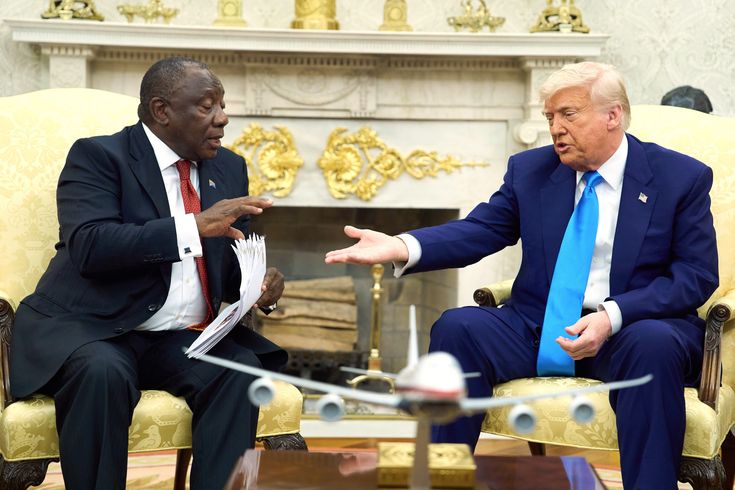
During a meeting at the White House in May, Trump directly confronted South African President Cyril Ramaphosa, claiming that white farmers in South Africa were being “killed and persecuted.” The administration even played a video claiming to show graves of murdered farmers, though subsequent investigations revealed the footage originated from a 2020 protest unrelated to the alleged killings.
South Africa’s ambassador to Washington, Ebrahim Rasool, sharply criticized Trump’s stance, accusing him of “mobilizing a supremacism” and using “white victimhood as a dog whistle.” Despite this backlash, Trump remains steadfast in his belief that the policy is both morally and politically justified.
President Ramaphosa, for his part, dismissed the claims, stating that “there is doubt and disbelief about all this in [Trump’s] head.” He emphasized that violence in South Africa is a national issue affecting people of all races. Official data supports his position — between October and December 2024, there were 7,000 murders in the country, of which only 12 were related to farm attacks, and only one victim was a farmer.
A Record Low for Refugee Admissions
This marks the second time Trump caps refugee admissions at record low levels. In his first administration, he set the limit at 15,000 — then the lowest in modern U.S. history. The new 7,500 ceiling not only surpasses that record but also symbolizes the administration’s ongoing “America First” philosophy, which prioritizes domestic interests over international humanitarian obligations.
The Global Refuge CEO, Krish O’Mara Vignarajah, condemned the decision, saying:
“This decision doesn’t just lower the refugee admissions ceiling — it lowers our moral standing as a nation.”
Humanitarian groups warn that the new cap could effectively shut the door on refugees from countries such as Afghanistan, Venezuela, and Sudan, where millions face severe humanitarian crises. They argue that the United States, once a beacon for displaced people, is turning its back on its legacy of compassion.
Political and Global Implications
Trump’s decision also carries major geopolitical implications. By focusing refugee admissions on white South Africans, the administration risks diplomatic tension with African nations and international bodies. Analysts believe it could fuel further accusations of racial bias within U.S. foreign policy.
Nevertheless, Trump has defended his stance, reiterating that the U.S. must “protect its people and prioritize its resources.” He insists the move is not discriminatory but strategic — ensuring that refugee resettlement aligns with American interests.
As this policy unfolds, one fact remains clear: Trump caps refugee admissions at record low, setting a precedent that could redefine how the U.S. approaches refugee policy in the years to come. Whether viewed as necessary reform or moral regression, the decision has already reshaped global conversations about race, security, and humanitarian responsibility.
Source: BBC News