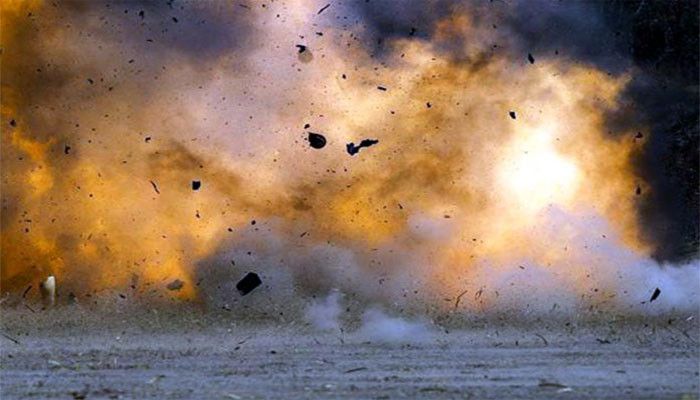
Islamabad Bomb Blast has once again shaken Pakistan’s capital, leaving at least 12 people dead and 27 others injured in what officials are describing as a suicide bombing outside the District Judicial Complex. The powerful explosion occurred at approximately 12:39 pm local time (07:39 GMT) on Tuesday, November 11, 2025, creating scenes of chaos and destruction in one of Islamabad’s most secure zones.
According to Interior Minister Mohsin Naqvi, the attacker detonated explosives near a police vehicle after failing to enter the court premises. “The bomber attempted to breach the gate of the judicial complex but was stopped by security personnel. He then detonated his vest, killing 12 people, including police officers, and injuring more than two dozen others,” Naqvi told reporters at the scene.
The blast — which occurred near one of Islamabad’s busiest legal centers — marks the deadliest attack in the capital in recent years and underscores the fragile security situation amid mounting cross-border tensions with Afghanistan.
The Scene: Chaos and Panic Outside the Court
Witnesses described a harrowing scene moments after the explosion. Rustam Malik, a lawyer present at the complex, told AFP, “It was complete chaos. Lawyers and people were running inside the complex. I saw two dead bodies lying at the gate and several cars on fire.”
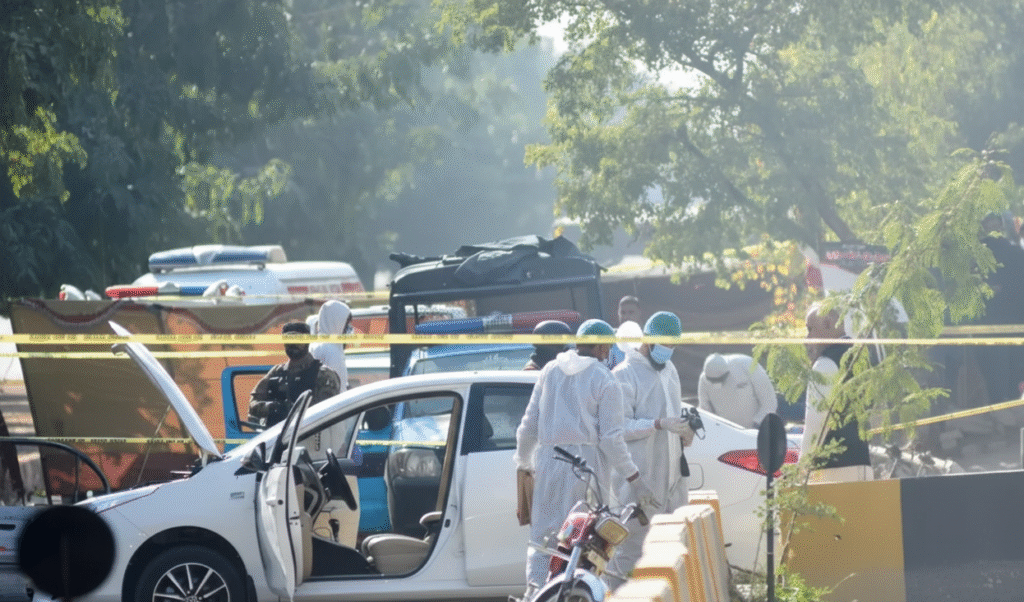
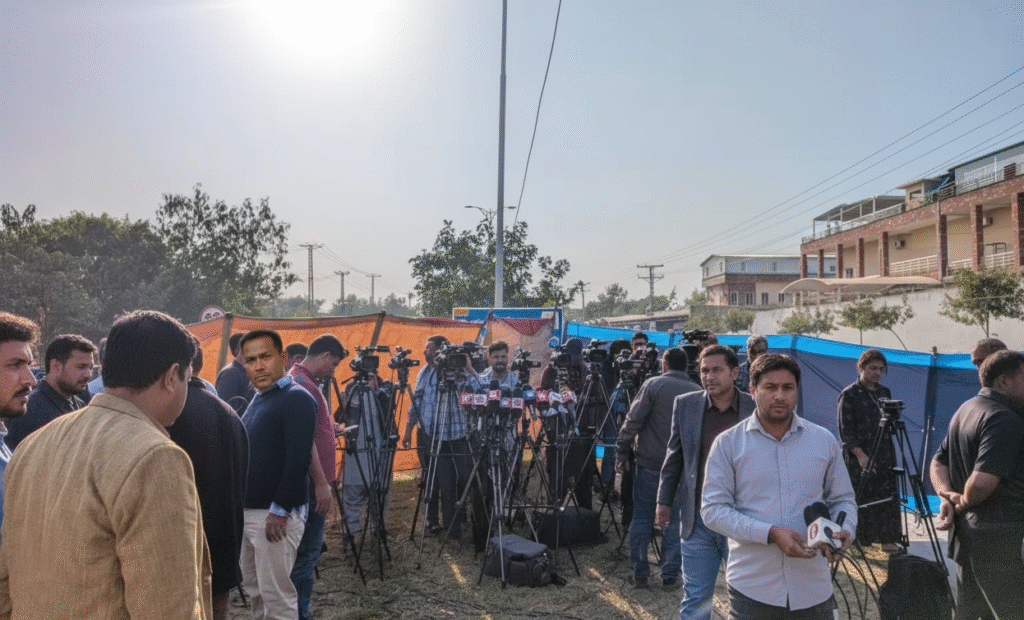
Photographs from Reuters and Anadolu Agency show police cordoning off the area as ambulances rushed victims to Pakistan Institute of Medical Sciences (PIMS). Forensic teams combed through charred vehicles and debris outside the court entrance, collecting evidence to confirm the type of explosives used.
The blast site — a usually crowded area filled with litigants, lawyers, and law enforcement officers — was quickly sealed off. Islamabad’s Deputy Commissioner ordered an immediate lockdown of nearby roads and buildings, while security forces began a door-to-door search for possible accomplices.
Suicide Attack Confirmed: A Targeted Strike on Law Enforcement
Pakistan’s Interior Ministry confirmed that the explosion was caused by a suicide bomber who targeted a police vehicle stationed near the court. “Our investigators have confirmed that it was a suicide bombing. The attacker was on foot and detonated his explosives after being intercepted by police,” said Naqvi.
Authorities have yet to determine which militant group was behind the attack, but early suspicion points toward groups operating along the Afghan border. Defence Minister Khawaja Asif declared that Pakistan was “in a state of war,” warning that the attack should serve as a wake-up call for the country’s security apparatus.
“In this environment, it would be futile to hold out greater hope for successful negotiations with the rulers of Kabul,” Asif said on X (formerly Twitter). “The rulers of Kabul can stop terrorism in Pakistan, but bringing this war all the way to Islamabad is a message from Kabul.”
A Deadly Chain of Events: Attack Follows Foiled Siege in Wana
The Islamabad Bomb Blast came just hours after Pakistani forces foiled an attempted hostage situation at a cadet college in Wana, located in Khyber Pakhtunkhwa province near the Afghan border. The overnight assault began late Monday, when armed men and a suicide bomber tried to storm the military-run institution.
According to police chief Alamgir Mahsud, soldiers killed two attackers at the gate while three others managed to infiltrate the administrative block before being cornered by army commandos. “We conducted a clearance operation, but the explosion destroyed several nearby houses and wounded at least 16 civilians,” Mahsud reported.
Security analysts are investigating whether the two incidents — the college siege and the Islamabad blast — are linked, possibly indicating a coordinated escalation by militant networks seeking to destabilize major urban centers.
Heightened Security and Emergency Response
Following the attack, Islamabad authorities placed all public institutions, government buildings, and transportation hubs under high alert. Police checkpoints were reinforced, and bomb disposal units were deployed to key entry points of the capital.
Interior Minister Mohsin Naqvi said, “We have ordered a complete review of security in Islamabad and other major cities. Additional forces are being deployed, and intelligence coordination with provincial governments has been strengthened.”
Hospitals in Islamabad and Rawalpindi have been directed to remain on emergency footing, with medical teams treating dozens of victims suffering from burns, shrapnel wounds, and head trauma. Dr. Amir Jamal, an emergency physician at PIMS Hospital, confirmed that several victims were in critical condition.
Political Reactions: Condemnations and Calls for Unity
President Asif Ali Zardari strongly condemned the attack, calling it a “cowardly and barbaric act” aimed at destabilizing the country. “The perpetrators of this heinous act will not escape justice,” he said in an official statement.
Prime Minister Shehbaz Sharif, currently on a diplomatic visit to China, expressed sorrow over the loss of life and vowed swift retribution. “Pakistan has defeated terrorism before, and we will defeat it again. Our resolve to protect our people remains unshaken,” Sharif said in a televised address.
Former Prime Minister Imran Khan also took to social media, writing, “The Islamabad blast is a reminder of our collective failure to secure peace. Political differences aside, Pakistan must unite against terrorism in all its forms.”
International Condemnations
The international community swiftly condemned the bombing. The United Nations issued a statement expressing solidarity with Pakistan, calling the attack a “grim reminder of the global threat of extremism.”
The United States Embassy in Islamabad released a security alert advising American citizens to avoid the affected area and remain vigilant. “We condemn this senseless act of violence and stand with the people of Pakistan in their fight against terrorism,” the statement read.
China, Pakistan’s closest regional ally, expressed “deep shock” and reaffirmed support for Pakistan’s counterterrorism efforts. “China condemns this attack and supports Pakistan in safeguarding its national security,” said Foreign Ministry spokesperson Mao Ning.
Rising Tensions With Afghanistan
The bombing has also reignited tensions between Pakistan and Afghanistan. Islamabad has long accused Kabul of harboring members of the Tehreek-e-Taliban Pakistan (TTP), a banned militant group responsible for numerous attacks across the country.
“Pakistan has repeatedly asked the Afghan Taliban to rein in terrorist groups operating from their soil,” said retired general Talat Masood. “But this attack shows that cross-border networks remain active and capable.”
Afghanistan’s government has not yet issued an official response. However, analysts believe this latest violence will further strain the already fragile relations between the two neighbors.
Witness Accounts: A City in Shock
Residents living near the court complex recounted scenes of fear and confusion. “The explosion was so loud it shattered my windows,” said Zahra Hussain, who lives two blocks away. “For a moment, it felt like an earthquake. Everyone ran out of their homes, and there was smoke everywhere.”
Lawyer Salman Awan, who narrowly escaped the explosion, said he had just entered the complex when he heard the blast. “People were running, shouting, and falling over each other. The smell of gunpowder was strong, and all I could see was fire and black smoke.”
Pakistan’s Struggle Against Terrorism
The Islamabad Bomb Blast marks a grim chapter in Pakistan’s decades-long struggle with militancy. Although large-scale attacks in the capital have become rare in recent years, sporadic incidents continue to claim lives.
Analysts warn that the resurgence of terrorist activity near major cities could indicate a shifting strategy among militant networks aiming to exploit political instability and regional conflict. “These attacks are designed to erode public confidence in the state’s ability to maintain security,” said counterterrorism expert Dr. Ayesha Siddiqa.
As investigators continue their probe, Pakistan’s leadership faces renewed pressure to implement stronger intelligence-sharing mechanisms and address the root causes of extremism that continue to threaten national stability.
This report is based on information originally published by Al Jazeera, with additional analysis and context provided by FFR News.