Australia social media ban for children: why the world is watching
Australia social media ban for children under 16 has moved from political talking point to hard law – and Silicon Valley is scrambling to catch up.
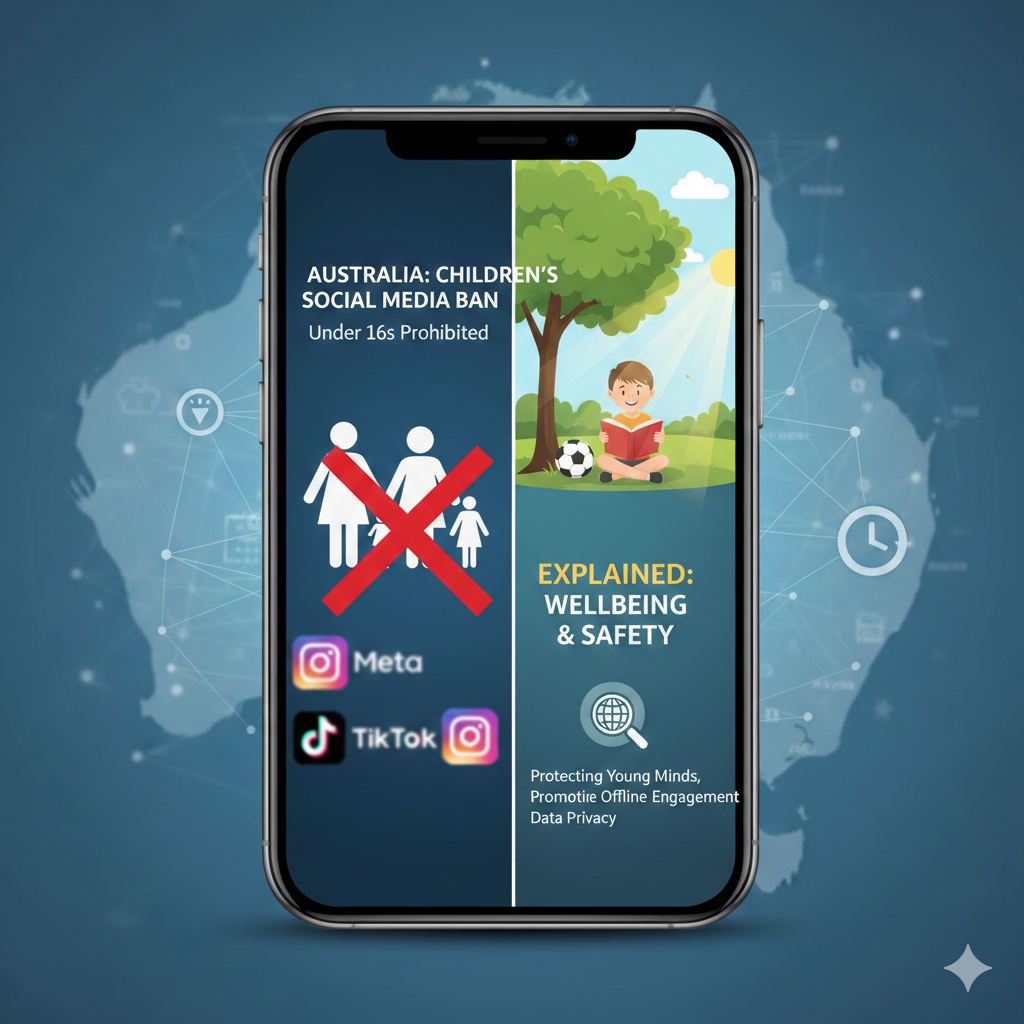
From 10 December, any major platform operating in Australia – from Instagram and TikTok to YouTube, Snapchat, X, Reddit and others – must stop users under the age of 16 from holding accounts or face penalties of up to A$49.5m (about US$33m, £25m) for serious or systemic breaches.
To comply, companies are being forced into something they have resisted for years: robust age-verification and “age assurance” systems for every user, not just for children. For tech firms whose business models depend on frictionless sign-ups and data-driven targeting, that is a seismic change.
Supporters in Canberra frame the Australia social media ban for children as a necessary “seatbelt moment” – imperfect, perhaps, but a long-overdue safety device after a decade of mounting evidence that social platforms can harm young people’s mental health. Critics, including industry lobby groups, civil-liberties advocates and some academics, warn of overreach, censorship and privacy risks, and question whether the ban will work in practice.
Regardless of where you stand, this world-first experiment matters far beyond Australia’s borders. Governments from the EU to Brazil and Singapore are watching closely, weighing up whether to copy – or avoid – the Australian model.
From Silicon Valley optimism to a ‘seatbelt moment’
To understand how Australia ended up pioneering such a hard-line policy, it helps to look back at how attitudes to social media have shifted.
Stephen Scheeler, who ran Facebook Australia in the early 2010s, remembers the early days as a period of “heady optimism”. Social media platforms promised to connect the world, democratise information and allow people to build their own digital public squares without traditional gatekeepers.
By the time he left in 2017, his faith was badly shaken. “There’s lots of good things about these platforms, but there’s just too much bad stuff,” he now says, arguing that companies hid from genuine public debate about the downsides of their products.
Scheeler sees the Australia social media ban for children as a “seatbelt moment” – an imperfect but necessary attempt to add basic safety rules to a technology that has, for years, raced ahead with minimal restraints. In his view, even flawed regulation is better than “nothing, or better than what we had before”.
What exactly does Australia’s law do?
At its core, the new regime sets a nationwide minimum age for social media accounts and hands the regulator real teeth.
Under legislation passed in 2024 and due to be enforced from December 2025:
- No accounts for under-16s on designated “age-restricted platforms”, including Facebook, Instagram, TikTok, Snapchat, YouTube, X, Threads, Reddit and Kick.
- Platforms must take “reasonable steps” to prevent under-age users from having accounts – a deliberately flexible test that will evolve with technology.
- Companies must age-verify all users, new and existing, using methods such as AI age estimation or document checks.
- The eSafety Commissioner can investigate, demand information and impose fines up to A$49.5m for serious or systemic non-compliance.
- There is no parental-consent workaround: even if a parent approves, a 15-year-old is still banned. That makes the Australia social media ban for children stricter than laws in Utah, Florida or the EU, which generally allow parental approval as an exception.
Communications minister Anika Wells has made clear that the government knows age assurance will take time to get right, but insists the era of voluntary, lightly enforced “community standards” is over. If eSafety finds systemic failures, she says, “platforms will face fines”.
Why target kids? The safety and mental-health argument
Proponents of the ban say it responds to a growing body of evidence – from leaked internal documents, academic research and heartbreaking testimonies – that social media can exacerbate depression, anxiety, body-image issues and self-harm among young people.
In the US, a wave of lawsuits filed by parents and school districts alleges that Meta, TikTok, Snapchat and YouTube deliberately designed features like infinite scroll, autoplay and streaks to be addictive, while downplaying internal research linking heavy use to mental-health problems and child exploitation. A landmark trial consolidating hundreds of these claims is due to begin in early 2026, with Meta CEO Mark Zuckerberg and Snap boss Evan Spiegel ordered to testify in person.
Whistleblowers such as Frances Haugen and Arturo Béjar have accused Meta of putting growth and engagement ahead of safety, including for teens. Béjar recently co-authored a report finding that nearly two-thirds of safety tools in Meta’s new “Instagram Teen Accounts” either failed to work as promised or were easy to circumvent – a finding Meta disputes.
Beyond Meta, platforms have faced criticism over:
- The spread of extreme violence, hate speech and terrorist propaganda;
- Viral challenges and self-harm content reaching young users even if they were not searching for it;
- Sophisticated sexual predators grooming teens via direct messages and disappearing content.
Parents like Tammy Rodriguez, whose 11-year-old daughter died after being sexually exploited on Instagram and Snapchat, have testified before US Congress that current safeguards are simply not enough.
Against that backdrop, Wells argues that tech firms have had “15, 20 years” to fix the problems voluntarily and have failed. The Australia social media ban for children, she says, is a response to that failure and a signal that children’s mental health now outweighs Silicon Valley’s convenience.
How big tech is scrambling to respond
For platforms, the Australia social media ban for children is expensive, complicated – and potentially contagious if other countries copy it.
Many of the affected companies spent the past year lobbying hard against the law, warning that:
- The ban could push young people onto unregulated or fringe sites, making them less safe.
- Age-verification tech is intrusive and fallible, raising privacy and data-security worries.
- The law infringes children’s rights to information and expression.
NetChoice, a trade group representing platforms including Meta, X and Google, accused Australia of “blanket censorship” that would leave its youth “less informed, less connected, and less equipped to navigate the spaces they will be expected to understand as adults”.
At the same time, tech leaders worked behind the scenes to influence the final shape of the ban. Snap chief Evan Spiegel flew to Australia for direct talks with Wells; YouTube reportedly deployed beloved children’s band The Wiggles as lobbyists; and several firms argued that Apple and Google – as gatekeepers of the app stores – should shoulder responsibility for verifying users’ ages.
Publicly, companies insist they will “meet their legal obligations” while continuing to argue that a parental-consent model would be better. Meta, for example, says legislation should “empower parents to approve app downloads and verify age”, rather than imposing a flat ban.
New safety features – and their limits
Faced with the Australia social media ban for children, big tech has rushed to showcase new teen-safety features and age-verification tools – not just in Australia, but worldwide.
Some of the key changes include:
YouTube’s AI age-estimation
YouTube is rolling out AI systems that estimate a user’s age based on signals like the types of videos watched, search history and account behaviour, regardless of the birthdate entered at sign-up. Teens identified by the system are automatically put into more protective settings, with personalised ads disabled, some content restricted and “digital wellbeing” reminders switched on.
Instagram Teen Accounts
Meta’s “Instagram Teen Accounts” automatically place users under 18 in private profiles with stricter filters on mature content, tougher anti-bullying settings and time-limit reminders. Teens under 16 in some markets need a supervising parent account to change baseline protections.
However, independent testing led by Béjar and child-safety groups concluded that around two-thirds of these tools were ineffective or easily bypassed, arguing that Meta’s promises had “failed to match reality”. Meta strongly rejects those findings.
Snapchat “family” and teen modes
Snapchat has promoted special teen accounts and “Family Center” tools that give parents more oversight while limiting features like location sharing and contact from unknown users for 13–17-year-olds.
Reddit’s reluctant compliance
Reddit, which has argued that it is more of a knowledge-sharing forum than a social network, has nevertheless announced that it will comply with the Australia social media ban for children. It will use a “privacy-preserving age-prediction model” and birthdate prompts to identify and suspend under-16s, even as it labelled the law “legally erroneous” and hinted at a possible High Court challenge.
Despite these moves, experts and whistleblowers are sceptical. They point out that many platforms have a history of over-hyping safety features that end up being difficult for teens to use, or easy for determined bad actors to avoid.
Age verification: the heart of the controversy
Because the Australia social media ban for children hinges on age assurance, the choice of verification methods is crucial – and deeply contested.
Platforms are experimenting with a mix of approaches:
- Self-declared birthdates, backed by AI models that flag accounts whose behaviour suggests they may be underage.
- Document checks using IDs like passports or driving licences, often outsourced to third-party providers.
- Biometric estimation, where a user submits a selfie or short video and AI estimates their age range.
Critics worry that these systems either collect too much sensitive data or are too inaccurate to justify a national ban. Civil-liberties groups argue that forcing every user to prove their age amounts to a form of identity tracking that erodes online anonymity – a key protection for activists, whistleblowers and vulnerable groups.
The government counters that the law requires “reasonable steps”, not perfect systems, and that it has deliberately avoided prescribing a single technology. The eSafety Commissioner will work with Stanford University to evaluate the outcomes over at least two years, potentially refining the rules as evidence emerges.
Still, the technical and ethical challenges are enormous. No major democratic country has previously tried to enforce such a sweeping, age-based lockout on mainstream social platforms.
Will kids just work around the ban?
One of the most common criticisms of the Australia social media ban for children is simply that teenagers are resourceful.
Opponents note that:
- Many under-16s already lie about their age to sign up – something tougher verification might reduce, but not eliminate.
- Tech-savvy teens can access foreign sites via VPNs, messaging apps, gaming platforms or smaller services not covered by the law.
- There is a risk that vulnerable young people could be pushed onto less moderated, more extreme corners of the internet.
Supporters accept that some teenagers will slip through, but argue that regulation doesn’t need to be perfect to make a difference. Seatbelts don’t prevent every injury, they say; they just reduce the overall risk.
Scheeler and others also argue that the ban will force a broader cultural shift by sending a clear signal to parents, schools and the tech industry that unfettered access is no longer normal or acceptable for younger teens.
The global ripple effect of Australia’s experiment
What makes the Australia social media ban for children especially significant is not only what it does at home, but what it might inspire abroad.
Wells says counterparts from the EU, Fiji, Greece, Malta, Denmark and Norway have already contacted her for advice. Denmark and Norway are reported to be working on similar laws; Singapore and Brazil are watching closely; and child-safety advocates in the UK and US see Australia as proof that bold action is politically possible.
Other jurisdictions have already moved in the same direction, albeit with less sweeping measures:
- Utah requires parental consent for under-18s to use social media, limits usage to three hours a day, and imposes curfews between 10:30pm and 6:30am, though parts of its law have faced court challenges.
- Florida and other US states have discussed or passed similar curfews and default restrictions.
- The EU’s Digital Services Act requires large platforms to assess and mitigate systemic risks, including to minors, and bans targeted advertising to children, but stops short of a blanket age cutoff.
Think-tanks such as the Cato Institute warn that Australia’s model, if replicated, could restrict online speech globally and embolden more authoritarian governments to tighten control over the digital public square under the banner of child protection.
For big tech, that possibility is alarming. If Australia’s experiment is judged a success – or simply politically popular – companies fear it could become a “proof of concept” that triggers a wave of copycat laws in far larger markets.
Fines, loopholes and the ‘cost of doing business’
Australia’s fines sound dramatic – up to A$49.5m per serious breach – but for trillion-dollar tech titans, they may ultimately be manageable.
Marketing professor Ari Lightman suggests that some firms might eventually treat occasional penalties as a cost of doing business, especially if strict compliance risks driving away teen users who form the next generation of their customer base.
Because the law relies heavily on the eSafety Commissioner’s investigations and enforcement choices, much will depend on how aggressively the regulator pursues cases and how courts interpret “reasonable steps”. Platforms also retain considerable influence over how smoothly things go in practice.
Analysts like Nate Fast note that companies have an incentive to “walk a fine line”: complying enough to avoid a full-blown regulatory war, but not so successfully that other countries look at Australia and say, “Great, that works – let’s do the same.”
Parents, teens and the question of who decides
Another core tension in the Australia social media ban for children is who gets to decide what is appropriate for a 14- or 15-year-old: the state, the platforms, or the parents?
Tech firms argue that parents, not governments, know their own children best. They say that many families find social media invaluable for staying connected, discovering interests and accessing support communities – from LGBTQ+ groups to mental-health resources. In their view, a model where parents approve apps and supervise usage strikes a better balance than a hard age cutoff.
Australian ministers counter that reality looks different: parental controls are underused, algorithms overwhelm family rules, and many children are effectively unsupervised online. They also point out that some of the most vulnerable teenagers – including those in abusive households – may be least able to rely on parental permission but most need protection from predatory platforms.
Teenagers themselves are divided. Some Australian teens interviewed by broadcasters say they resent being locked out of spaces where much of their social life happens. Others admit they are relieved at the idea of having a socially acceptable excuse to step back from apps they know are harming their mood and self-esteem.
Australia social media ban for children: bold leadership or dangerous precedent?
So is the Australia social media ban for children a brave, necessary correction – or a risky overreach?
Supporters say:
- It finally forces tech companies to take child safety seriously after years of half-measures.
- It creates room for families and schools to cultivate healthier offline habits during a critical developmental window.
- It establishes a legal baseline that can later be refined as evidence accumulates.
Critics reply that:
- A blanket age ban is a blunt instrument that may push young people into darker corners of the web.
- Age-verification schemes threaten privacy and online anonymity.
- Decisions about teens’ digital lives should be made by families, not governments, and certainly not in ways that could chill legitimate speech.
Even some supporters, like Scheeler, acknowledge that the policy is experimental. “Maybe it will work, maybe it won’t,” he says, “but at least we’re trying something.”
What happens next will depend on how rigorously Australia enforces the law, how creatively teenagers adapt, how sincerely platforms improve their products – and how other governments react to the results.
If the ban reduces harm without major unintended consequences, it could become the template for a new era of regulated, age-aware social media. If it fails, or creates new problems, it may still serve as a cautionary tale about the difficulties of governing global tech with national laws.
Either way, the age of laissez-faire social media for children is ending. The debate over what should replace it is only just beginning.
EXTERNAL SOURCES FOR REFERENCE
You can add these sources at the end of your WordPress post for readers who want to dive deeper:
- Reuters – “Australia social media ban set to take effect, sparking global crackdown”
https://www.reuters.com/business/media-telecom/australia-social-media-ban-set-take-effect-sparking-global-crackdown-2025-12-09/ - BBC / MyJoyOnline syndication – “Australia’s social media ban for children has left big tech scrambling”
https://www.myjoyonline.com/australias-social-media-ban-for-children-has-left-big-tech-scrambling/ - Australian Government – Anika Wells press conference and eSafety platform list
https://minister.infrastructure.gov.au/wells/transcript/press-conference-canberra-0 - Guardian – “Reddit to comply with Australia’s ‘legally erroneous’ under-16 social media ban”
https://www.theguardian.com/australia-news/2025/dec/09/reddit-to-comply-with-australias-legally-erroneous-under-16-social-media-ban - Silicon Republic – “Meta hits back at Australia’s social media ban for under-16s”
https://www.siliconrepublic.com/business/meta-australia-government-social-media-ban-bill-children-teenagers - Cato Institute – “Australia’s Under 16 Social Media Ban: A Warning for Online Speech Security Around the World”
https://www.cato.org/blog/australias-under-16-social-media-ban-warning-online-speech-security-around-world - YouTube Official Blog – “Extending our built-in protections to more teens on YouTube”
https://blog.youtube/news-and-events/extending-our-built-in-protections-to-more-teens-on-youtube/ - Fairplay & Arturo Béjar report – “Instagram Teen Accounts fail to protect children”
https://fairplayforkids.org/instagram-teen-accounts-fail-to-protect-children-safety-tools-testing-reveals/ - Guardian – “Instagram still poses risk to children despite new safety tools, says Meta whistleblower”
https://www.theguardian.com/technology/2025/sep/25/instagram-risk-children-safety-tools-meta - Utah Social Media Laws summary (official site)
https://socialmedia.utah.gov/