📰 Trump-Brokered Truce Collapses: Fierce Fighting Erupts Between Thailand and Cambodia as President Vows New Intervention
The fragile peace between Thailand and Cambodia, which U.S. President Donald Trump hailed as a major foreign policy success just months ago, has violently collapsed. Intense new border fighting—the most severe since a deadly flare-up in July—erupted on December 8, 2025, leaving at least 13 people dead and displacing hundreds of thousands of civilians. The renewed conflict has thrust the two Southeast Asian nations back onto the global stage, with President Trump publicly announcing his intention to again intervene and end the war he had previously boasted of stopping.
The widespread combat, which has seen the use of heavy artillery, rockets, and even airstrikes by the Royal Thai Air Force (RTAF), marks a devastating failure of the truce signed in October at a summit attended by Trump. Now, amid conflicting reports of who started the renewed violence, all eyes are on the potential for a fresh diplomatic effort to halt the bloodshed and address the deep-seated, century-old territorial dispute that continues to fuel this devastating cycle of violence.
The Collapse of the US-Brokered Truce Between Thailand and Cambodia
The latest round of hostilities between Thailand and Cambodia shatters the fragile ceasefire agreement that had been formally extended in October 2025. President Donald Trump, who took personal credit for ending the previous surge in fighting in July, stood alongside the leaders of both nations during the signing of the peace accord at the ASEAN summit in Kuala Lumpur. Trump cited this as one of at least eight conflicts he had successfully halted in the final 11 months of his presidency.
However, the truce proved fatally inadequate in the face of deep-seated mutual distrust and unresolved issues. The ceasefire was intended to be a stepping stone towards long-term peace, committing both nations to coordinated actions like de-mining and the withdrawal of heavy weapons. Implementation, however, stalled almost immediately.
- Landmine Incidents: Just weeks after the October signing, the Royal Thai Army (RTA) suspended its implementation of the deal following landmine explosions that injured several soldiers near the border. Thailand accused Cambodia of planting new mines, a claim Phnom Penh denied, arguing any mines were decades old.
- Unresolved Grievances: Crucially, the deal failed to address the core territorial grievances that have been the root cause of the conflict for over a century. The two nations continued to accuse each other of provocative actions and border encroachment.
The situation spiraled into full-scale conflict on Monday, December 8, 2025. Both Bangkok and Phnom Penh relayed wildly conflicting accounts of the initial spark, each blaming the other for firing the first shots. The Thai army claimed Cambodian forces launched fire across the border around 3:00 am local time, while Cambodia accused the Thai military of intense shelling and the use of armed drones.
Renewed Violence and the Humanitarian Crisis on the Border
The fighting has quickly escalated into the most intense period of combat since July, spreading across multiple disputed border points and leading to a significant loss of life and a large-scale humanitarian crisis.
Casualties and Displacement
The human cost of the renewed conflict is staggering:
- Casualties: Initial reports indicate a total of 13 people have been killed, including 9 civilians in Cambodia and four soldiers in Thailand. Dozens more have been injured.
- Mass Displacement: The violence has triggered a mass evacuation on both sides of the border. By Wednesday, December 10, over half a million evacuees in Cambodia and Thailand were reportedly sheltering in pagodas, schools, and temporary safe havens. Thai military spokespersons confirmed that over 400,000 people have been evacuated from affected districts, while Cambodia evacuated more than 127,000 villagers.
The sheer scale of the displacement highlights the devastating impact of the war on civilian populations, who are forced to leave their homes, valuables, and livestock behind to seek safety.
Escalation and Military Tactics
The use of sophisticated military assets indicates a significant escalation in the conflict:
- Thai Air Power: The Royal Thai Air Force (RTAF) admitted to carrying out airstrikes, stating they were targeted on “weapon depots, command centres and logistical routes assessed as direct threats,” not civilian areas. Thailand also reported the use of tanks and anti-drone positions.
- Cambodian Counter-Claims: Cambodia’s military accused Thailand of using artillery fire, armed drones, and firing mortars into civilian residences in Battambang province. Cambodia also alleged that Thai F-16 fighter jets had entered Cambodian airspace and dropped bombs near civilian areas. Thailand’s military also reported that Cambodian forces fired approximately 125 salvos from BM-21 launchers, totaling about 5,000 rockets, with some hitting civilian areas.
- Attacks on Civilian Infrastructure: Rockets fired by Cambodian forces reportedly landed near the Phanom Dong Rak Hospital in Surin district, Thailand, forcing the evacuation of patients and staff.
Sporting Withdrawal
In a further sign of the severity of the crisis, Cambodia withdrew its team from the Southeast Asian Games in Thailand, citing safety fears, just a day after the team participated in the Games’ opening ceremony in Bangkok.
The Historical Roots of the Thailand and Cambodia Border Dispute
To understand the volatile nature of the current conflict, one must look back over a century of unresolved tension. The core of the Thailand and Cambodia border dispute lies in a disagreement over colonial-era maps and the sovereignty of highly sacred ancient temple sites.
Colonial Maps and the 1907 Border
The fundamental disagreement stems from a map drawn in 1907 when Cambodia was a French protectorate within French Indochina, and Thailand was known as Siam.
- The French Map: French officials produced a topographical map intended to define the border. This map placed several key areas and ancient temple sites on the Cambodian side, deviating from the natural watershed line that Thailand argued should form the boundary.
- Thai Rejection: Thailand has long rejected the accuracy of this French colonial-era map, claiming the border was incorrectly demarcated and arguing that the French survey was not legally binding.
The International Court of Justice and Temple Sovereignty
The dispute reached an international legal body, but the ruling only served to cement nationalistic resentment in Thailand:
- 1962 ICJ Ruling (Preah Vihear): The International Court of Justice (ICJ) ruled in 1962 that the 11th-century Preah Vihear temple—a stunning Khmer Shiva shrine perched on a cliff edge—was situated in territory under the sovereignty of Cambodia. Thailand was obligated to withdraw its armed detachment.
- 2013 ICJ Reaffirmation: This ruling was reaffirmed in 2013, ordering the withdrawal of troops from the area.
- Enduring Thai Anger: Despite the ICJ decision, the ruling remains politically sensitive in Thailand, with many Thais viewing the loss of the land surrounding the temple as a national betrayal.
Temples as Flashpoints
The disputed area is dotted with other ancient, highly significant temple complexes, which frequently become flashpoints for hostilities, underscoring the spiritual and cultural dimensions of the conflict:
- Ta Kwai Temple (Prasat Ta Muen Thom): The 11th-century Ta Kwai Temple (or Prasat Ta Muen Thom) in Thailand’s Surin province, near the Cambodian border, came under heavy attack in the latest fighting and was partially damaged. Thai military reported Cambodian forces using heavy fire around the site.
- Preah Vihear and Ta Moan Thom: Cambodia, in turn, accused the Thai army of shelling positions near the Preah Vihear and Ta Moan Thom temples.
These ancient Khmer Empire sites are not merely pieces of land; they are symbols of national identity and cultural heritage for both sides. The conflict is thus not just a territorial disagreement but a war over history, memory, and dignity, which is instrumentalized by political elites in both nations.
Trump’s Vow to Intervene Again to Stop the Thailand and Cambodia War
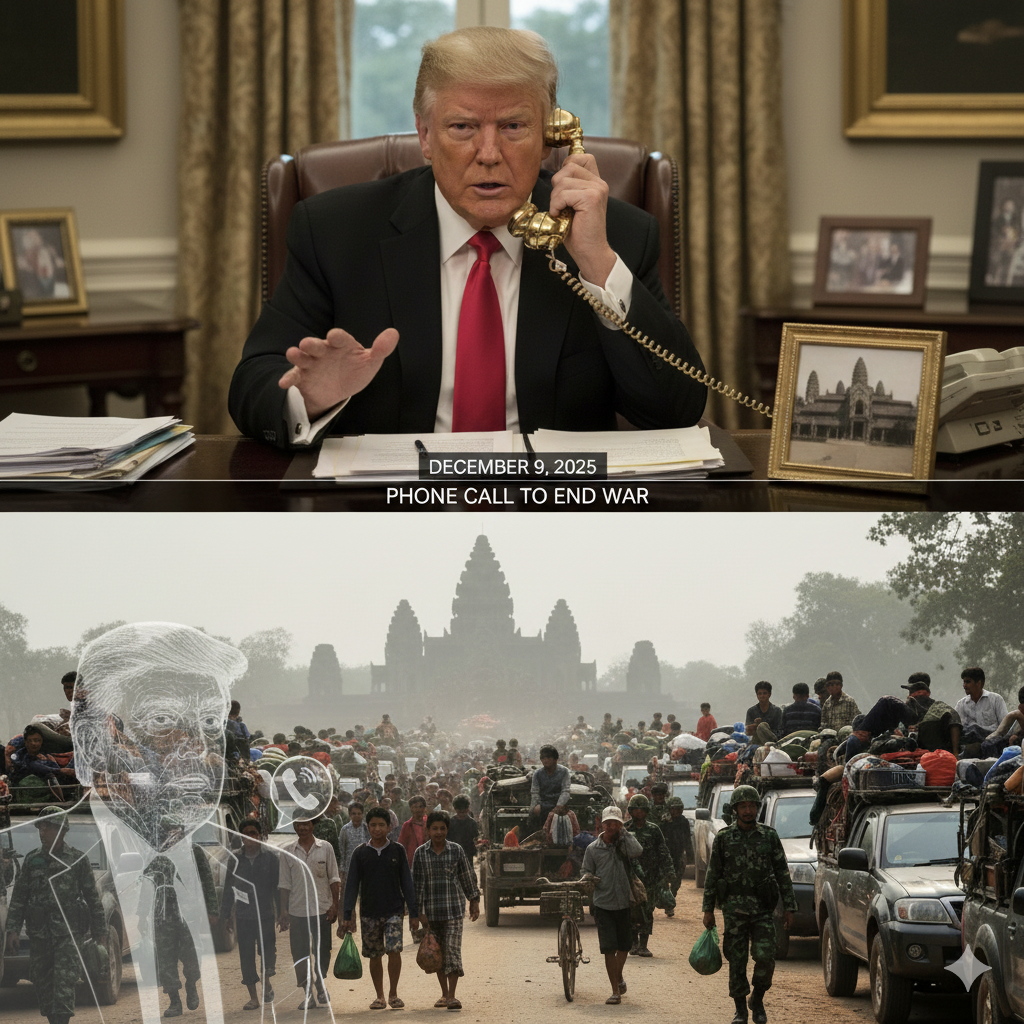
Following the news of the renewed conflict, U.S. President Donald Trump, speaking at a rally in Pennsylvania, publicly committed to re-engaging to stop the fighting.
“I hate to say this, Cambodia and Thailand started up today and tomorrow I am going to have to make a phone call,” Trump stated. He then boasted of his unique ability to de-escalate such situations: “Who else could say ‘I’m going to make a phone call and stop a war between two very powerful countries, Thailand and Cambodia’?”
The Leverage of US Diplomacy
Trump’s previous intervention in July, which was described as an “emergency intervention” following five days of deadly cross-border fighting, relied heavily on American trade leverage. Reports suggest Trump personally telephoned both leaders and warned that tariff negotiations with Washington could freeze unless the combat stopped. The threat of economic repercussions proved sufficient to bring the parties to the negotiating table, leading to the October truce.
However, the rapid and violent collapse of that same truce—which left the fundamental issues of border demarcation and troop disposition unaddressed—raises serious questions about the long-term effectiveness of transactional, high-pressure diplomacy that lacks a robust follow-up mechanism for implementation and conflict resolution.
The Path Forward
As the fighting continues, the need for a swift, multilateral intervention is clear.
- Immediate Ceasefire: The first priority for any new diplomatic push, led by Trump or other regional bodies like ASEAN, must be to secure an immediate and strictly monitored ceasefire that is more robust than the October agreement.
- Addressing the Root Cause: For a lasting peace, the intervention must move beyond a temporary halt to hostilities and facilitate a process to address the fundamental border demarcation issue, potentially involving renewed mediation or a technical commission to work on the colonial-era maps and historical claims.
- Humanitarian Access: Any agreement must ensure humanitarian corridors and safe access to the hundreds of thousands of displaced civilians who are in urgent need of aid and shelter.
Cambodian government spokesperson Pen Bona confirmed that Phnom Penh’s position remains the same: it wants peace. However, with both the Thai Prime Minister and the Cambodian government vowing to continue fighting to defend their territory, the challenge for President Trump’s promised phone call—and for the wider international community—will be to overcome the deep-seated mistrust and nationalistic fervor that continue to turn ancient heritage sites into modern-day battlefields.
The international community, including the UN, has urged restraint and a recommitment to the ceasefire. This renewed conflict between Thailand and Cambodia serves as a stark reminder that peace deals negotiated under pressure are only as durable as the underlying commitment to resolving the historical and territorial wounds that precipitated the crisis in the first place.
External Sources and References
These external sources provide authoritative context on the conflict’s history, the International Court of Justice rulings, the humanitarian crisis, and the fragility of the recent diplomatic efforts.
- Renewed Conflict & Humanitarian Crisis:
- The Associated Press (AP): Renewed Thailand-Cambodia border fighting displaces hundreds of thousands
- Reference for mass displacement figures, civilian casualties, and Anutin’s vow to fight.
- URL:
https://apnews.com/article/thailand-cambodia-border-dispute-fighting-displaced-3f6300a3e77bbf0479acc6f8ceace12d
- The Guardian: Thailand launches airstrikes along disputed border with Cambodia as tensions flare
- Reference for air strikes, civilian casualties, and Hun Sen’s influential post.
- URL:
https://www.theguardian.com/world/2025/dec/08/thailand-airstrikes-disputed-border-cambodia
- Times of India: Border clash: Thailand launches air strikes on Cambodia; Trump’s ceasefire on edge — what we know
- Reference for the landmine incident and Thailand’s suspension of the deal.
- URL:
https://timesofindia.indiatimes.com/world/rest-of-world/border-clash-thailand-launches-air-strikes-on-cambodia-tensions-flare-what-we-know/articleshow/125824403.cms
- The Associated Press (AP): Renewed Thailand-Cambodia border fighting displaces hundreds of thousands
- Historical & Legal Context (Preah Vihear Dispute):
- International Court of Justice (ICJ) – 1962 Judgment: Temple of Preah Vihear (Cambodia v. Thailand)
- Primary legal source for the 1962 ruling on the temple’s sovereignty.
- URL:
https://www.icj-cij.org/case/45
- United Nations News: UN court rules for Cambodia in Preah Vihear temple dispute with Thailand
- Reference for the 2013 ICJ reaffirmation and the ruling on the entire promontory territory.
- URL:
https://news.un.org/en/story/2013/11/455062
- Stanford University (FSI – SPICE): Thailand and Cambodia: The Battle for Preah Vihear
- Reference for the 1907 French map, 1941 Thai occupation, and the nationalist dimensions of the dispute.
- URL:
https://spice.fsi.stanford.edu/docs/thailand_and_cambodia_the_battle_for_preah_vihear
- International Court of Justice (ICJ) – 1962 Judgment: Temple of Preah Vihear (Cambodia v. Thailand)
- ASEAN and External Mediation:
- Asia Media Centre: Thai-Cambodia Border Conflict Reignites
- Reference for the July ceasefire being brokered by Malaysia (ASEAN Chair) and President Trump.
- URL:
https://www.asiamediacentre.org.nz/thai-cambodia-border-conflict-reignites
- CNA: Has domestic politics in Thailand and Cambodia fuelled latest border flare-up?
- Reference for domestic political instability in Thailand as a contributing factor.
- URL:
https://www.channelnewsasia.com/asia/thailand-cambodia-border-conflict-anutin-5571901
- Asia Media Centre: Thai-Cambodia Border Conflict Reignites