
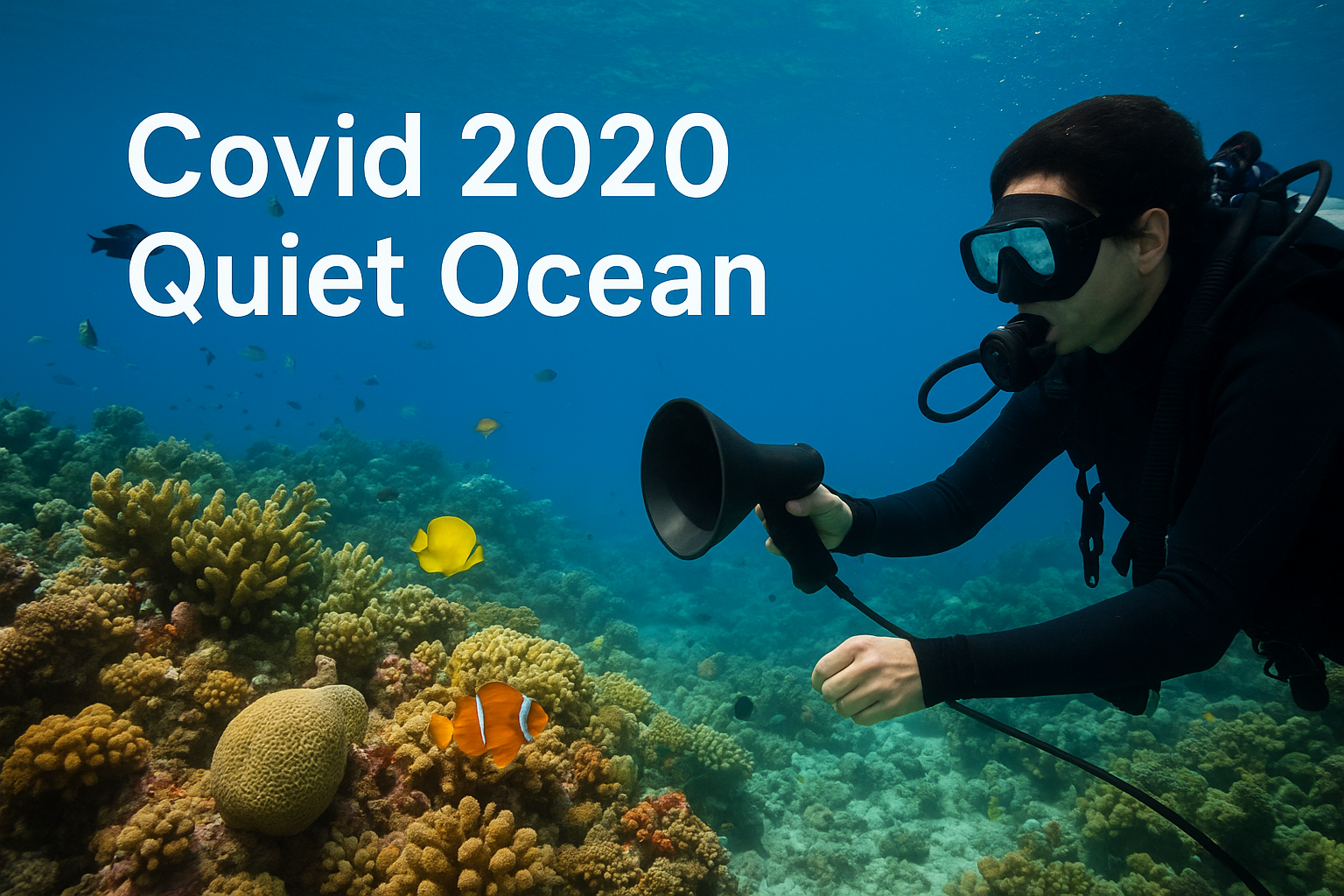
Covid 2020 quiet ocean conditions created one of the most unexpected environmental experiments in modern history. As the world slowed to a halt during pandemic lockdowns, the oceans — long dominated by the constant roar of human activity — experienced a rare and profound silence. Cargo ships paused, tourism collapsed, and coastal traffic nearly vanished. In that quiet, scientists began to hear something extraordinary: the true voice of the sea.
For decades, marine biologists suspected that underwater noise pollution was altering ocean ecosystems, but they lacked a global-scale opportunity to measure its impact. Covid-19 changed that overnight. What followed was an unprecedented window into how marine life communicates, survives, and thrives when human noise recedes.
Covid 2020 Quiet Ocean: When Shipping Fell Silent
By early 2020, more than 90 percent of global trade — normally carried by massive container ships — slowed dramatically. According to international shipping data, maritime trade declined by more than four percent, while some regional shipping lanes saw traffic drop by as much as 70 percent.
This reduction had a direct acoustic effect. Computer models later estimated that global underwater noise energy dropped by approximately six percent, a significant change in a system usually dominated by relentless low-frequency hums from ship engines.
To marine scientists, this moment was priceless.
Listening to the Ocean Without Humanity’s Roar
For much of human history, people believed the ocean was largely silent. That illusion existed because human ears are poorly adapted to underwater sound. The introduction of hydrophones — underwater microphones — in the early 20th century shattered that assumption.
Marine ecosystems, researchers discovered, are alive with sound: crackling shrimp, clicking dolphins, singing whales, and chorusing fish create what scientists call a soundscape.
Dr Steve Simpson, a marine biologist at the University of Bristol, describes it as an orchestra.
“Thousands of different instruments playing at the same time,” he says. “Together, they create a living soundtrack that defines ocean health.”
During Covid 2020 quiet ocean conditions, that orchestra was no longer drowned out.
Why Sound Matters Underwater
Sound is not optional for marine life — it is essential.
Unlike light, which fades rapidly underwater, sound travels efficiently through the ocean. Many species rely on it to:
- Find food
- Avoid predators
- Choose mates
- Defend territory
- Navigate vast distances
Research suggests nearly two-thirds of all fish species produce sound, while whales can communicate across hundreds — even thousands — of kilometers using deep sound channels in the ocean.
When noise pollution interferes, survival itself is at risk.
The International Quiet Ocean Experiment Comes to Life
Long before Covid-19, scientists envisioned reducing ocean noise as an experiment. That idea became the International Quiet Ocean Experiment (IQOE), founded by marine researchers including Professor Peter Tyack of the University of St Andrews.
The challenge was scale.
“You can’t just turn down the volume of the ocean,” Tyack explained. “It’s expensive, complex, and global.”
Covid-19 did what science alone could not — it turned down the world’s oceans almost overnight.
Covid 2020 Quiet Ocean Effects in New Zealand
One of the clearest examples came from New Zealand’s Hauraki Gulf Marine Park, one of the busiest waterways in the country.
When lockdown began on 26 March 2020:
- Boat traffic nearly stopped
- Underwater noise dropped to one-third of normal levels within 12 hours
- Dolphin and fish communication ranges expanded by up to 65 percent
For dolphins, that meant calls traveled over a mile farther than before.
Scientists described the shift as immediate and dramatic — proof that even small changes in vessel activity can radically reshape underwater acoustics.
The Hidden Voices of Fish and Shrimp
Covid 2020 quiet ocean conditions also revealed how loud nature itself can be.
Snapping shrimp, tiny crustaceans found in shallow waters, produce sounds exceeding 210 decibels — louder than a gunshot. They snap their claws so rapidly that they create collapsing bubbles capable of stunning prey.
Fish, too, contribute to the soundscape. Many species grunt, croak, hum, or drum, especially during breeding seasons. These sounds guide larvae to reefs and signal healthy habitats.
When reefs fall silent, it is often a sign of ecological collapse.
Anthropogenic Noise: The Third Sound Layer
Traditionally, ocean soundscapes consisted of:
- Biophony – sounds from living organisms
- Geophony – natural sounds like wind, rain, and ice
Modern oceans added a third layer:
- Anthrophony – human-generated noise
This includes:
- Cargo ships
- Speedboats
- Offshore construction
- Military sonar
- Seismic surveys
Unlike natural sounds, anthropogenic noise is constant, unpredictable, and often low-frequency — the most disruptive type for marine animals.
Stress, Silence, and Survival
Studies conducted before and during Covid 2020 quiet ocean periods show alarming patterns.
In Colombia, humpback whales fed less frequently and at shallower depths as ship noise increased.
In Australia:
- Migrating humpback whales extended dive durations when boats were nearby
- Mothers with calves were significantly more sensitive to vessel presence
- Southern right whales experienced sharply reduced rest time during whale-watching activities
Noise does not merely annoy marine animals — it alters behavior, increases stress, and reduces reproductive success.
Military Sonar and Whale Strandings
Perhaps the most disturbing connection is between military sonar and whale strandings.
Beaked whales exposed to intense sonar pulses have shown:
- Internal hemorrhaging
- Brain and ear trauma
- Bubble lesions resembling decompression sickness
These injuries suggest panic-driven surfacing, where whales ascend too rapidly, causing fatal physiological damage.
Covid-19 quiet ocean conditions reduced such exposures in some regions, offering researchers a clearer baseline of whale behavior without sonar interference.
Fish Parenting Under Pressure
Noise affects even the smallest details of marine life.
Experiments on Ambon damselfish revealed that motorboat noise caused male fish to:
- Spend 34 percent more time vigilant
- Reduce feeding behavior
- Provide less care to eggs
On coral reefs, sound cues guide larvae toward suitable habitats. Noise pollution masks those cues, reducing successful settlement and weakening reef recovery.
The Ocean’s Mental Health Crisis
Marine biologists increasingly describe noise pollution as a mental health issue for ocean life.
Chronic stress:
- Shortens lifespan
- Suppresses immune function
- Reduces fertility
Just as constant noise affects humans in cities, it has similar consequences underwater — but marine animals cannot escape.
Using Sound to Heal the Ocean
One of the most hopeful discoveries from Covid 2020 quiet ocean research is that sound can also restore ecosystems.
Scientists now use acoustic enrichment, playing recordings of healthy reef soundscapes through underwater speakers to attract fish back to damaged areas.
“We’re basically advertising thriving neighborhoods,” says Simpson.
The results are promising — faster fish settlement, increased biodiversity, and improved reef recovery.
World Ocean Passive Acoustics Monitoring Day
Inspired by the quiet of 2020, researchers launched World Ocean Passive Acoustics Monitoring (WOPAM) Day on 8 June 2023.
Participants around the globe record underwater soundscapes:
- Urban canals
- Coral reefs
- Rivers and ponds
What began as a small idea shared over a beer became a worldwide movement celebrating the sounds of the sea.
What Covid 2020 Quiet Ocean Taught Humanity
The pandemic revealed something uncomfortable and profound: human activity fundamentally reshapes the planet’s soundscape.
When we paused, the ocean did not fall silent — it came alive.
This natural experiment proved:
- Noise pollution is reversible
- Small reductions can have massive impacts
- Ocean health depends on acoustic balance
A Blueprint for a Quieter Future
While permanent global lockdowns are neither possible nor desirable, the lessons of Covid 2020 quiet ocean conditions offer solutions:
- Quieter ship designs
- Speed reductions near sensitive habitats
- Rerouted shipping lanes
- Seasonal noise limits during breeding periods
Silencing the ocean is not the goal. Listening to it is.
As scientists continue analyzing data from that extraordinary year, one truth resonates clearly: when humanity quiets down, the ocean speaks — and what it tells us may determine the future of life beneath the waves.
For Further Coverage
Read more on BBC News and for more news on Environment and Earth follow FFRNews Environment section.

It’s fascinating how reduced shipping noise had such a noticeable impact on marine life; I found some interesting related information on https://tinyfun.io/game/plants-vs-brain-zombies while researching ocean ecosystems. I wonder what the long-term effects of these quieter periods will be.