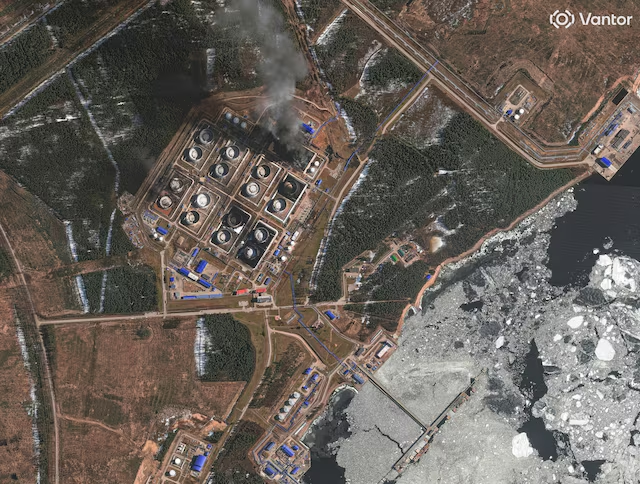
Primorsk oil terminal drone attack has dealt a major blow to Russia’s energy infrastructure, with satellite images confirming that at least 40% of the facility’s storage capacity was destroyed during recent strikes. The attack marks one of the most significant disruptions to Russian oil exports since the beginning of the war in Ukraine, raising concerns about global energy stability.
According to satellite intelligence reviewed by Reuters, at least eight large oil storage tanks at the Baltic Sea port of Primorsk were damaged. Each tank had a capacity of around 50,000 cubic metres, representing a substantial portion of the terminal’s storage and operational capability.
The scale of the destruction is expected to severely impact Russia’s ability to export oil, as Primorsk is one of the country’s most important energy hubs.
Primorsk Oil Terminal Drone Attack Hits Key Export Hub
The Primorsk oil terminal drone attack targeted one of Russia’s largest and most strategically important oil export facilities. Located on the Baltic Sea, the port has the capacity to handle approximately 1 million barrels of oil per day—nearly 1% of global supply.
This makes Primorsk a critical node in Russia’s energy export network, particularly for shipments to Europe and global markets.
Satellite imagery revealed extensive damage to storage infrastructure, including multiple reservoirs essential for maintaining oil flow through the port. These reservoirs play a crucial role in balancing supply and ensuring smooth loading operations for tankers.
With such a large portion of storage capacity destroyed, analysts warn that the port’s throughput may be significantly reduced in the coming weeks or even months.
Ukraine Intensifies Attacks on Russian Energy Infrastructure
The Primorsk oil terminal drone attack is part of a broader escalation in Ukraine’s strategy to target Russian energy assets.
Over the past month, Ukrainian forces have launched some of their most intense drone strikes on Russia’s western energy corridor. These attacks have focused on critical infrastructure, including oil terminals, refineries, and pipeline systems.
Another major Baltic port, Ust-Luga, was also hit multiple times in late March, forcing temporary suspensions of export operations.
Together, these attacks have significantly disrupted Russia’s oil export logistics and reduced its ability to move crude and refined products to international markets.
In total, industry sources estimate that up to 40% of Russia’s oil export capacity was affected at one point due to a combination of drone strikes, pipeline disruptions, and tanker seizures.
Global Oil Supply Faces New Uncertainty
The impact of the Primorsk oil terminal drone attack extends far beyond Russia.
As one of the world’s largest oil exporters, any disruption to Russian supply can have immediate consequences for global energy markets. The loss of storage capacity at Primorsk, combined with damage to other facilities, has already contributed to tightening supply conditions.
Additional reports suggest that Russia may be forced to reduce oil production due to limited export capacity and storage constraints.
If production cuts are implemented, the effects could ripple through global markets, potentially driving oil prices even higher at a time when energy costs are already elevated due to conflicts in the Middle East.
The situation underscores how interconnected global energy systems are, with regional conflicts capable of triggering worldwide economic impacts.
Strategic Importance of Primorsk and Ust-Luga
The Primorsk oil terminal drone attack highlights the vulnerability of Russia’s Baltic export infrastructure.
Primorsk and Ust-Luga together form a critical gateway for Russian oil exports. These ports handle millions of barrels per day and are essential for maintaining the country’s energy revenue.
Damage to both facilities in quick succession represents a coordinated effort to disrupt Russia’s ability to finance its war efforts through oil exports.
Satellite images also showed that storage tanks at Ust-Luga were damaged, accounting for around 25% of its capacity.
The combined impact of these strikes has created bottlenecks in Russia’s energy logistics system, forcing companies to reassess operations and potentially scale back production.

Kremlin Responds to Drone Attacks
Russian officials have condemned the strikes, with Kremlin spokesperson Dmitry Peskov describing them as “terrorist attacks.”
Authorities have stated that efforts are underway to strengthen the protection of critical infrastructure, particularly energy facilities that are vital to the country’s economy.
However, defending such a vast network of oil terminals, pipelines, and refineries presents a significant challenge. The recent attacks have exposed vulnerabilities that may be difficult to address quickly.
Analysts suggest that the frequency and effectiveness of the drone strikes indicate a shift in modern warfare tactics, where relatively low-cost technology can inflict substantial damage on high-value targets.
Economic Consequences for Russia
The Primorsk oil terminal drone attack could have serious economic implications for Russia.
Oil and gas revenues are a major source of income for the Russian government. Disruptions to export capacity can reduce revenue flows, affecting the country’s ability to fund both domestic programs and military operations.
Reports indicate that Russian oil export revenues have already declined significantly following recent attacks, highlighting the financial impact of infrastructure damage.
If disruptions continue, Russia may face prolonged economic pressure, particularly if global markets adjust to reduced supply from one of the world’s largest exporters.
Broader Impact on Global Energy Markets
The consequences of the Primorsk oil terminal drone attack are being felt across global markets.
Energy traders are closely monitoring the situation, as uncertainty around supply can lead to price volatility. Higher oil prices can, in turn, impact inflation, transportation costs, and overall economic stability worldwide.
Countries that rely heavily on imported energy, particularly in Europe and Asia, may face increased costs and potential supply disruptions.
At the same time, competing oil producers could benefit from higher prices, potentially reshaping global energy dynamics in the long term.
A Turning Point in Energy Warfare
The Primorsk oil terminal drone attack represents a significant escalation in the conflict between Russia and Ukraine, with far-reaching implications for both regional and global stability.
By targeting critical energy infrastructure, Ukraine has demonstrated its ability to disrupt one of Russia’s most important economic sectors. The resulting damage not only affects Russia’s export capacity but also contributes to broader uncertainty in global energy markets.
As the conflict continues, the vulnerability of energy infrastructure is likely to remain a key factor shaping both military strategies and economic outcomes.
For broader international reporting, visit FFR NEWS. This report is based on verified reporting from Reuters and related energy market coverage.