
November 09, 2025
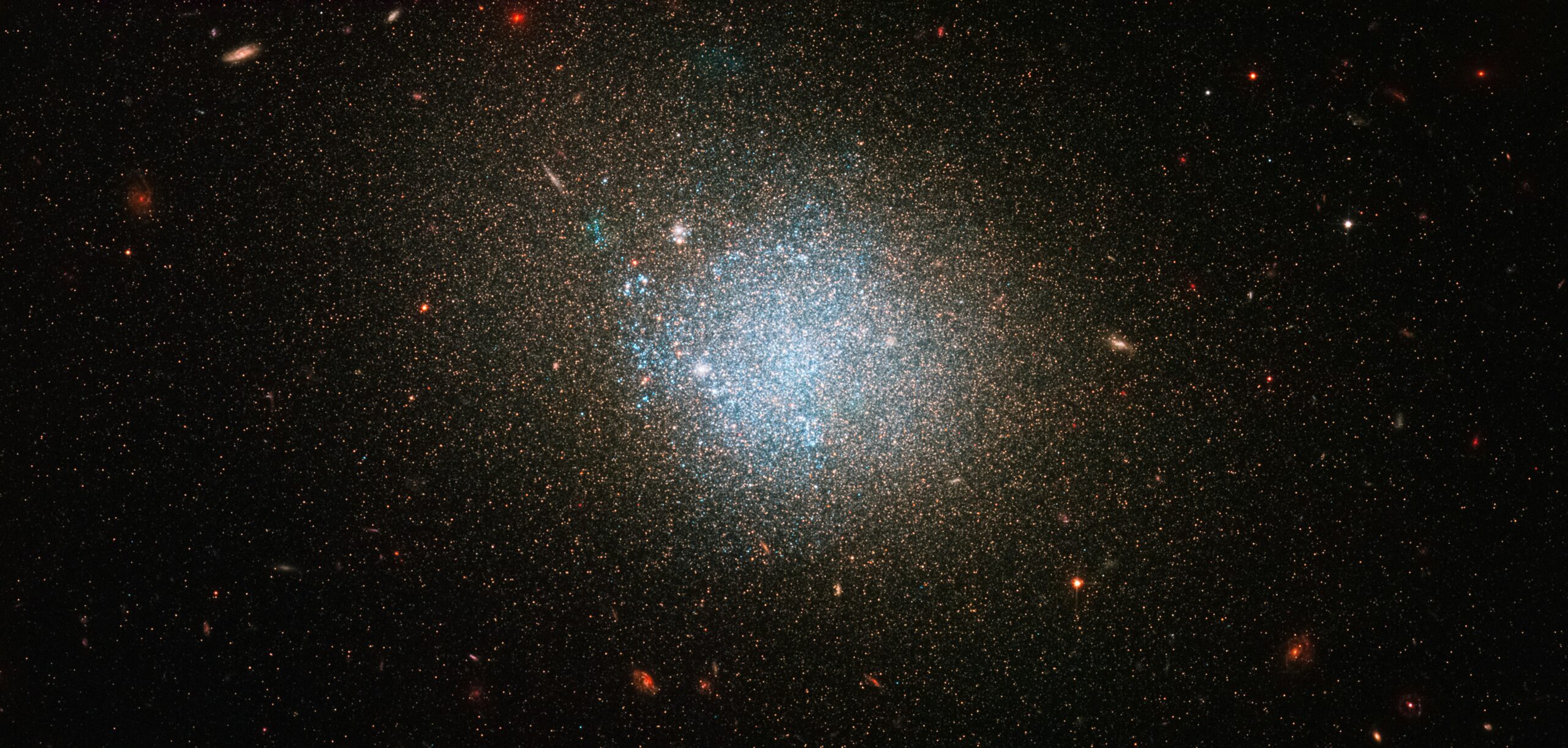
Dwarf galaxies dark matter debate — A new international study has shaken the foundations of modern astrophysics, offering the clearest evidence yet that dark matter may indeed dominate the unseen fabric of the cosmos. Researchers analyzing twelve of the faintest galaxies ever observed discovered that their internal gravitational forces cannot be explained by visible matter alone — a finding that challenges long-standing alternatives to dark matter and breathes new life into one of science’s most enduring mysteries.
A Mystery That Refuses to Fade
Dark matter has haunted cosmology since the 1960s, when scientists first noticed that galaxies were rotating faster than their visible mass could account for. Something invisible — some mysterious “missing mass” — had to be exerting gravitational pull to keep galaxies intact.
Over decades, countless missions and observatories have hunted for direct evidence of this dark component of the universe, yet none have conclusively detected it. Competing theories, such as Modified Newtonian Dynamics (MOND), have tried to explain these cosmic discrepancies by tweaking the laws of gravity themselves. But now, with the release of this new research led by the Leibniz Institute for Astrophysics Potsdam (AIP), MOND may be facing its most serious challenge yet.
The Dwarf Galaxies Experiment
The international team — including scientists from Potsdam University, the University of Surrey, University of Bath, Nanjing University, University of Porto, Leiden University, and Lund University — examined twelve of the smallest known galaxies in the universe. These dwarf galaxies, faint and compact, serve as pristine laboratories for testing gravitational theory because they contain far less visible matter than larger galaxies like the Milky Way.
Using high-precision stellar velocity data and state-of-the-art simulations performed at the DiRAC National Supercomputer Facility, researchers measured how stars move within these tiny galaxies. Their motion revealed a startling truth: the visible stars and gas alone couldn’t generate enough gravity to explain the observed dynamics.
In other words, something unseen — most likely dark matter haloes surrounding these galaxies — must be shaping their motion.
MOND Theory Fails the Test
For decades, the MOND hypothesis has offered a seductive alternative to dark matter. Instead of invoking invisible particles, MOND suggests that gravity itself behaves differently at extremely low accelerations. According to this idea, galaxies could rotate as they do without needing extra mass.
However, the latest data appear to invalidate MOND’s predictions for the smallest galaxies. Lead researcher Mariana Júlio, a PhD student at AIP, explained:
“For the first time, we resolved the gravitational acceleration of stars in the faintest galaxies at different radii, revealing their internal dynamics. Both our observations and simulations show that their gravitational field cannot be determined by visible matter alone. This contradicts modified gravity predictions.”
The results, published in Astronomy & Astrophysics, provide strong empirical support for dark matter models, especially those suggesting that every galaxy is embedded in an invisible halo of non-baryonic material.
Reinforcing the Case for Dark Matter
The findings also support a long-established concept known as the Radial Acceleration Relation (RAR) — the observed connection between visible mass and gravitational strength. While this relationship holds for large galaxies, the team found that RAR breaks down in dwarf galaxies, further proving that unseen mass plays a crucial role.
Professor Justin Read from the University of Surrey, a co-author of the study, elaborated:
“New data and modeling techniques are allowing us to map out the gravitational field on smaller scales than ever before. Our results show that what we see isn’t enough to explain the gravitational strength in these galaxies. The best explanation is that they are surrounded by invisible haloes of dark matter.”
This research strengthens the argument that dark matter remains the best explanation for a universe that behaves as though most of its mass is invisible.
Supercomputers, Simulations, and the Search for the Invisible
The study’s success relied heavily on high-resolution cosmological simulations performed using the EDGE project at the DiRAC National Supercomputer. By digitally reconstructing galaxy formation from the early universe to today, scientists could compare real-world observations with theoretical dark matter models.
The match between these simulations and actual data was remarkably precise, bolstering confidence in dark matter’s existence. Researchers say the next step will involve studying even fainter galaxies and probing whether dark matter behaves differently in extreme cosmic environments.
Implications for Cosmology
If these results hold up under further scrutiny, they could reshape how cosmologists model galaxy formation, cosmic structure, and the distribution of matter across the universe. Dark matter, once a theoretical convenience, is now looking increasingly indispensable.
Moreover, the study adds pressure on physicists to identify what dark matter is actually made of — whether WIMPs (Weakly Interacting Massive Particles), axions, or something entirely new. Experiments like XENONnT, LUX-ZEPLIN, and CERN’s ATLAS detector are currently chasing those elusive signals.
Why Dwarf Galaxies Matter
Dwarf galaxies may be small, but their simplicity is their strength. With fewer stars and less gas, they provide cleaner environments to isolate gravitational effects. As such, they are cosmic “testbeds” that expose flaws in competing gravitational theories.
Astrophysicist Helena Torres from the European Space Science Council (not affiliated with the study) told FFR News:
“Every time we look at dwarf galaxies, we’re peering into the universe’s most primitive structures. They carry the fingerprints of cosmic evolution — and perhaps the key to understanding dark matter itself.”
The Future of the Dark Matter Hunt
The AIP team plans to expand its survey to fainter and more distant dwarf galaxies, possibly using upcoming observatories like the Vera C. Rubin Observatory and ESA’s Euclid telescope. These facilities will allow even deeper exploration of galactic cores, where dark matter’s gravitational fingerprint may be clearest.
If similar results emerge from those observations, the balance could tip decisively in favor of the dark matter model — finally ending decades of scientific contention.
End of an Empire, Beginning of a Revelation
The new research on dwarf galaxies and the dark matter debate may not have found the invisible substance itself, but it has cornered the skeptics. By exposing the limits of modified gravity and reaffirming dark matter’s explanatory power, astronomers are closing in on one of the universe’s oldest riddles.
For now, these tiny galaxies — faint, ancient, and remote — are whispering cosmic truths that could transform our understanding of the universe’s hidden architecture. In their silence lies perhaps the loudest evidence yet: that dark matter isn’t just a theory — it’s the invisible scaffolding of creation itself.
This report is based on information originally published by Universe Today, with additional analysis and context provided by FFR Astronomy.