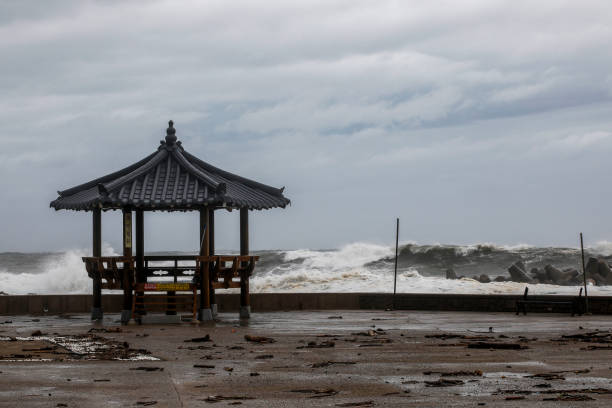
The world’s most powerful storm of 2025 has reached China. Typhoon Ragasa China made landfall in Zhuhai, Guangdong province, unleashing winds of over 100mph (160km/h), torrential rain, and a wall of seawater that has forced nearly two million people to flee their homes. The “king of storms,” as Chinese state media has called it, has already left devastation in the Philippines and Taiwan before barreling into the southern coast of mainland China.
Howling winds and a city under siege
In Zhuhai, a city of nearly three million people perched on the Pearl River Delta, rush hour fell silent. Streets that would normally be packed with commuters were eerily empty, save for the roar of winds and the hiss of rain.
Falling tree branches, flying debris, and loose metal sheets turned roads into hazards. Police vehicles patrolled the city with megaphones, urging residents to stay indoors, but their warnings were often drowned out by the storm itself.
From hotel windows, even reinforced glass creaked under the strain, while people inside watched the storm lash against high-rise buildings. For locals, there was no panic—just resignation. Many have faced typhoons before, but Ragasa’s power made this one different.
Ragasa’s destructive path before reaching China
Ragasa began its destructive march across the South China Sea after battering the Philippines and Taiwan.
- In eastern Taiwan, at least 15 people were killed after a mountain lake overflowed, sweeping away homes and infrastructure.
- In Hong Kong, steep waves and storm surges inundated coastal areas, injuring more than 60 people as winds toppled signs and shattered windows.
By the time it arrived in Zhuhai, Ragasa had already been declared the strongest typhoon of the year worldwide.
Mass evacuations and emergency preparations
Ahead of landfall, Chinese authorities ordered the evacuation of nearly two million people across Guangdong province. The government issued a rare red alert for high tides and coastal surges, warning of catastrophic flooding.
Zhuhai, a tourist hub known for golf resorts and theme parks, was transformed into a disaster zone.
- Families were relocated to evacuation centers across the city.
- Shops and restaurants shuttered early, though some resisted to avoid losing income.
- Local officials went door-to-door to ensure compliance with evacuation orders.
At hotels converted into temporary shelters, families arrived with whatever belongings they could carry, children running through hallways trying to make the best of the crisis.
A city prepared but battered
Zhuhai is no stranger to typhoons. Businesses lined their entrances with sandbags, and homeowners taped up windows to reduce damage. Workers were dispatched early to trim trees and remove loose branches that could turn into dangerous projectiles.
Police and neighborhood officers were stationed on street corners, beaches, and harbors to prevent thrill-seekers from venturing too close to the waves.
Despite these preparations, Ragasa’s intensity has pushed even seasoned residents to their limits.
China’s disaster response and criticism fears
Authorities in China are known for taking disaster preparedness seriously, partly to avoid the harsh criticism that follows when they are seen as underprepared.
Warnings for Ragasa came days before its arrival. By the weekend—while Ragasa was still pounding the Philippines—the Guangdong weather bureau had already warned citizens to brace for a “catastrophic disaster.”
Chinese state media underscored the rare severity of the warning, signaling how much officials feared the storm.
Extreme weather on the rise
Typhoon Ragasa is not an isolated event. Weather experts have been warning for years that typhoons in China are growing stronger and more frequent due to climate change. Rising ocean temperatures are fueling storms that are harder to predict and more destructive when they strike land.
2025 has already been a year of climate extremes for China:
- Severe heatwaves have scorched crops.
- Heavy floods have destroyed farmland and homes.
- Droughts and ruined harvests have added to economic strain.
Ragasa has become yet another test of China’s resilience in the face of an increasingly hostile climate.
Life inside the eye of the storm
For those trapped in Zhuhai during Ragasa’s landfall, the experience has been terrifying. Winds blew in sudden waves and bursts, making it nearly impossible to stand upright outdoors. Even indoors, families huddled in evacuation centers could hear the storm hammering at the city’s defenses.
But amid the chaos, life carried on. Some locals stubbornly refused to close businesses too early. Others, resigned to another typhoon, gathered in homes, waiting for the storm to pass.
One father stood near the ocean with his daughter, holding her hand as he snapped photos of the waves, seemingly calm despite the ferocity around them.
The storm is not over yet
Although Ragasa has officially made landfall, the crisis is far from finished. Meteorologists warn that heavy rain and landslides are likely to continue for days, especially in mountainous areas.
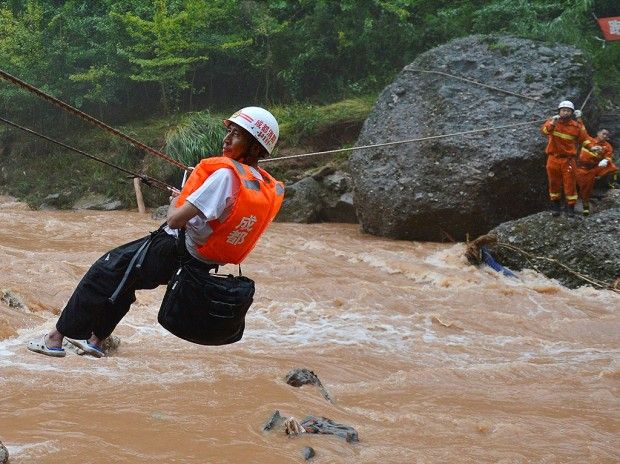
Rescue teams remain on high alert, as flooding and storm surges pose an ongoing threat to coastal communities. Officials are bracing for the possibility of even greater destruction as rivers overflow and soil erosion triggers landslides.
Conclusion
The arrival of Typhoon Ragasa China marks one of the most powerful storms to hit the country in years. With winds topping 100mph, mass evacuations, and warnings of catastrophic disaster, it has forced millions to confront the harsh reality of increasingly extreme weather.
For Zhuhai, the storm has brought a city to its knees, reminding residents that no matter how prepared they are, nature’s fury can overwhelm even the strongest defenses. And as experts warn of more intense typhoons in the years ahead, Ragasa may not be the last storm of its kind—but rather a sign of the future.
Source: BBC