
Gaza ceasefire and IDF withdrawal mark the first significant pause in Israel’s two-year war on Gaza. On Friday morning, Israeli forces began partially withdrawing from several areas across the Strip following a ceasefire agreement between Israel and Hamas. The move comes after Israel’s cabinet approved the first phase of US President Donald Trump’s ceasefire and hostage release deal, hailed by Washington as a breakthrough in negotiations that had eluded past administrations.
The Israel Defense Forces (IDF) confirmed they had repositioned troops to “agreed deployment lines” within Gaza but still control roughly half of the territory. Thousands of displaced Palestinians were seen traveling north—many on foot—returning to their homes amid widespread devastation.
The Ceasefire Deal: A Fragile Start
Under the terms of the first phase, Hamas has until Monday noon (10:00 BST) to release all remaining Israeli hostages. That includes 20 hostages believed to be alive and up to 28 sets of remains. In exchange, Israel will release approximately 250 Palestinian prisoners serving life sentences, with 100 expected to be freed into the West Bank, five to East Jerusalem, and others deported abroad.
A further 1,700 Palestinians detained from Gaza are also expected to be released.
In addition to the prisoner exchanges, the agreement mandates unrestricted humanitarian aid deliveries to Gaza, where famine and disease have gripped the population. Around 600 aid trucks are expected to enter Gaza daily, carrying food, fuel, and medical supplies. However, observers say it remains unclear whether these commitments have yet translated into increased aid on the ground.
The ceasefire marks a delicate moment. It offers hope for a temporary reprieve after months of relentless airstrikes and urban warfare that have devastated Gaza’s infrastructure and displaced millions.
Israel’s Partial Withdrawal
Eyewitnesses in Gaza City confirmed that Israeli forces had pulled back from the city’s northwestern outskirts toward the east, while troops in the south withdrew from areas around Khan Younis.
In a statement on social media, the IDF said its troops “began positioning themselves along the updated deployment lines” as of midday Friday. The army added that its Southern Command “will continue to remove any immediate threat.”
US special envoy Steve Witkoff confirmed that the IDF had “completed the first phase withdrawal” to what he called the “yellow line,” a reference to a map released by the White House showing troop positions in different ceasefire phases. During this phase, Israel is set to maintain control over 53% of Gaza.
The map outlines three stages of withdrawal, with each successive phase moving Israeli control further back and expanding humanitarian access zones.
Netanyahu’s Address and Future Phases
Israeli Prime Minister Benjamin Netanyahu declared in a televised address that his government was “fulfilling its promise to bring back all hostages.” He emphasized that the next stages of Trump’s plan involve Hamas being “disarmed and Gaza demilitarised.”
Despite Netanyahu’s assertions, Hamas has not publicly agreed to disarm, and many analysts question whether future phases of the agreement are politically or militarily viable.
Confusion also surrounded the exact timing of the ceasefire’s start, as airstrikes were reported in Gaza into the early hours of Friday. The Hamas-run health ministry said 17 people were killed within the past 24 hours despite the announced truce.
Life Amid the Ceasefire: Palestinians Return North
As IDF units pulled back, thousands of Palestinians began moving northward. Videos and photographs captured long columns of people walking along Gaza’s coastal road—some carrying their belongings, others pushing carts or holding children’s hands. Many appeared weak and malnourished after months of blockade and bombardment.
“The road is long and difficult, there’s no food or water,” said Alaa Saleh, a schoolteacher traveling north. “Hiring a car costs around 4,000 shekels (£924; $1,227), far beyond what most people can afford.”
Another returnee, Wael Al-Najjar, said he was determined to reach his home in Jabalia even if it no longer stood. “Even if the house is destroyed, even if it’s just rubble, we’ll go back, put up a tent, and return to our people,” he told the BBC.
Gaza in Ruins
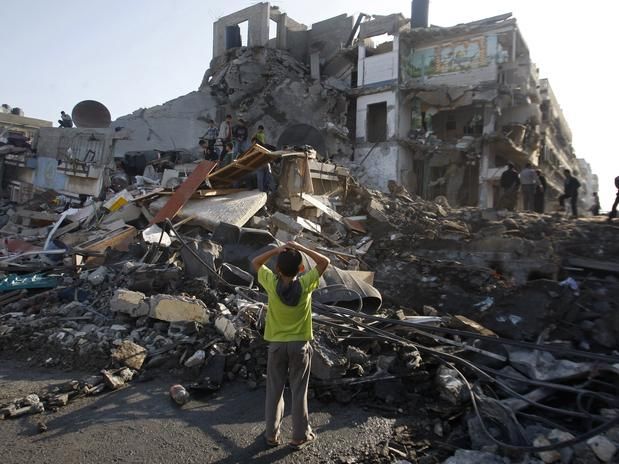
Much of Gaza City lies in ruins. Entire neighborhoods, including Sheikh Radwan, Sabra, and Zeitoun, have been flattened. Civil defense crews continue to recover bodies from beneath the debris while aid groups warn that food, clean water, and medicine remain critically scarce.
The UN and other humanitarian agencies describe the conditions as catastrophic, with famine officially declared in parts of Gaza back in August. More than half a million people face “starvation, destitution, and death,” according to UN-backed experts. Israel, however, has repeatedly denied accusations of deliberately restricting aid or causing starvation.
Reaction in Israel
In Israel, families of hostages greeted the ceasefire announcement with cautious relief. Uri Goren, who has campaigned for the return of his cousin’s body since Hamas’ October 2023 attack, said he felt “a big sigh of relief” upon hearing the news. Yet he remained wary, noting that Hamas admitted not knowing the locations of all hostages’ remains. “This will not end until all 48 are back home,” he said.
The Human Cost of the War
The war began after Hamas-led attacks on southern Israel on October 7, 2023, which killed about 1,200 people and saw 251 hostages taken. Since then, the Hamas-run health ministry claims that over 67,000 Palestinians have been killed, including more than 18,000 children.
The UN Commission of Inquiry and several international experts have accused Israel of committing genocide during the campaign, allegations Israel has strongly rejected as “distorted and false.”
A Fragile Hope for Peace
The Gaza ceasefire and IDF withdrawal mark a crucial but uncertain turning point in one of the bloodiest conflicts of the 21st century. While temporary calm has returned, questions linger about how long the truce will last — and whether it can evolve into a sustained peace.
As both sides prepare for the next negotiation phase, humanitarian agencies continue to plead for long-term stability, reconstruction, and accountability. For the millions of Gazans displaced or grieving loved ones, peace remains a distant hope, but for the first time in months, that hope flickers again.
Source: BBC