Hurricane Melissa Jamaica has plunged the Caribbean nation into a humanitarian crisis, with Black River — a coastal town in St Elizabeth parish — becoming the epicentre of devastation. In the wake of one of the strongest category five storms to ever strike the region, residents are scavenging for food, water, and basic necessities amid collapsed buildings and wrecked infrastructure.
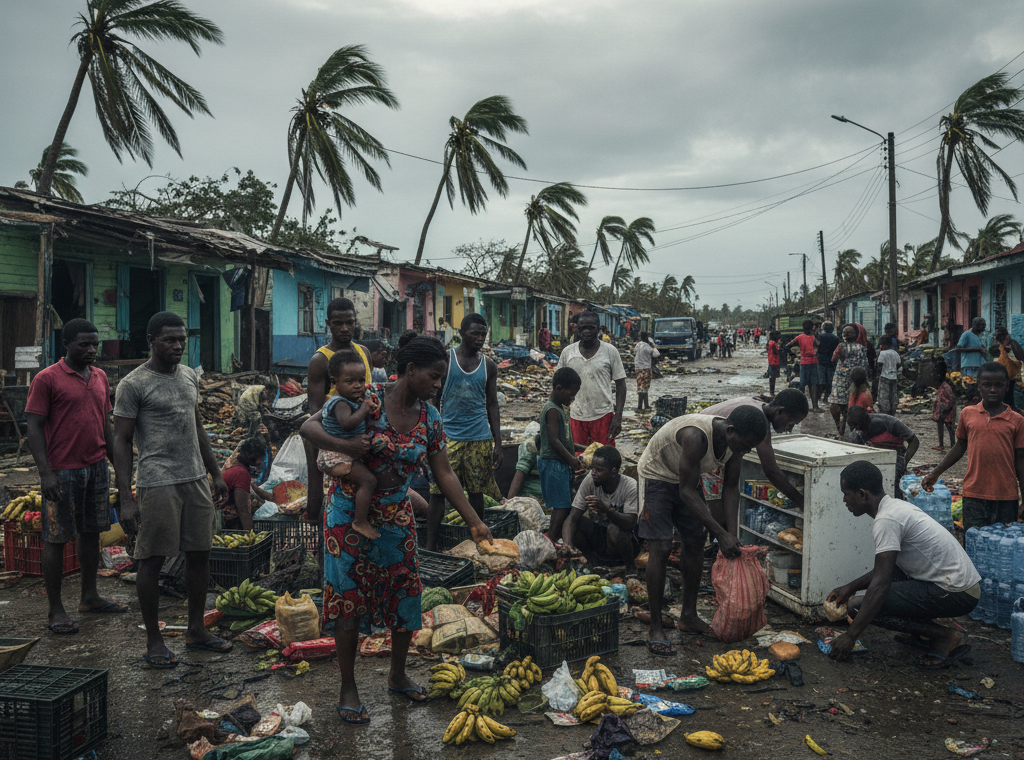
Days after the storm passed, the streets of Black River remain caked in mud and lined with debris. Locals wade through the wreckage, searching for anything salvageable. “We have to use whatever we see here, on the street and also in the supermarket,” said Demar Walker, one of the survivors, who climbed into a collapsed market to retrieve water and food for his neighbours.
The hurricane’s destructive power was unlike anything Jamaica has seen in decades. With winds exceeding 250 km/h, the storm tore through the island’s southern coastline, flattening homes, uprooting trees, and capsizing boats. Nearly 90% of the town’s houses are believed to have been destroyed, while crucial infrastructure — including the local hospital, police station, and fire station — lies in ruins.
Residents described scenes of desperation. Some people looted stores and pharmacies for food, medicine, and alcohol, as hunger and thirst overtook fear of law enforcement. “I saw items covered in mud being hauled out,” said Aldwayne Tomlinson, a witness to the chaos. “At first, I thought the place was still open, but then I realized it was looting.”
Local leaders have urged calm while acknowledging the despair. “It is a delicate balance,” said Mayor Richard Solomon of Black River. “People are seizing the opportunity to pick up what they can from damaged stores. However, others are becoming more forceful, trying to enter private properties for supplies.”
The Jamaican government confirmed that at least 19 people have died from the storm, a sharp increase from earlier counts, while another 30 fatalities have been reported in neighbouring Haiti. The true number may rise as search efforts continue in areas still cut off by flooding and landslides.
Survivors told the BBC that they have seen no aid trucks in the area. Many are forced to eat food found in the debris or rely on what little can be scavenged. “We need food. We have no food,” said Jimmy Esson, whose home was completely destroyed. “My community — we have dead bodies there,” added Walker, who has not been able to contact his family since the hurricane.
Communication remains nearly impossible in several areas. Roads are blocked or washed away, power lines are down, and cell service is nonexistent in most of the western region. Residents are now sleeping in the few structures still standing, while others have been left completely homeless.
Information Minister Dana Morris Dixon said the situation is dire: “Entire communities appear to be flattened. There are areas that seem to be marooned.” Relief efforts are underway, but progress is painfully slow. Aid shipments are arriving in Kingston, yet delivery to the hardest-hit regions — including Black River and Westmoreland — is hampered by damaged roads and airports.
Michael Tharkurdeen, a local medic, described the terrifying moments as Hurricane Melissa made landfall. “The entire bottom floor of the fire station was flooded. The water was about four or five feet high,” he said. “We couldn’t go downstairs — the waves were reaching shoulder height.” When the storm subsided, he found a lifeless man in the wreckage. “All we could do was document and cover his body,” he recounted.
By Friday afternoon, military helicopters arrived carrying armed personnel and supplies. Their presence brought temporary calm as residents paused scavenging in hope of receiving official aid. “It’s not about money,” said Shawn Morris, a local resident. “We need food and water.”
Hurricane Melissa has not only crippled Jamaica’s infrastructure but also exposed deep socioeconomic vulnerabilities. Experts warn that the long-term recovery will require international assistance and a comprehensive rebuilding strategy.
Climate scientists say storms like Melissa are becoming more intense due to rising sea temperatures and climate change. Jamaica, like many Caribbean nations, sits directly in the path of these increasingly violent systems, leaving it vulnerable to catastrophic losses.
For now, the people of Black River are focused on survival. With scarce resources, no communication, and widespread destruction, many are clinging to hope that aid will arrive before hunger and disease claim more lives. As one survivor put it, “Black River is broken, but we are still alive. We just need help.”
Source:
BBC