The Manchester anti-Islam march triggered a dramatic and highly charged confrontation in the heart of the city as far-right activists from Britain First faced off against a significantly larger crowd of antifascist counterprotesters.
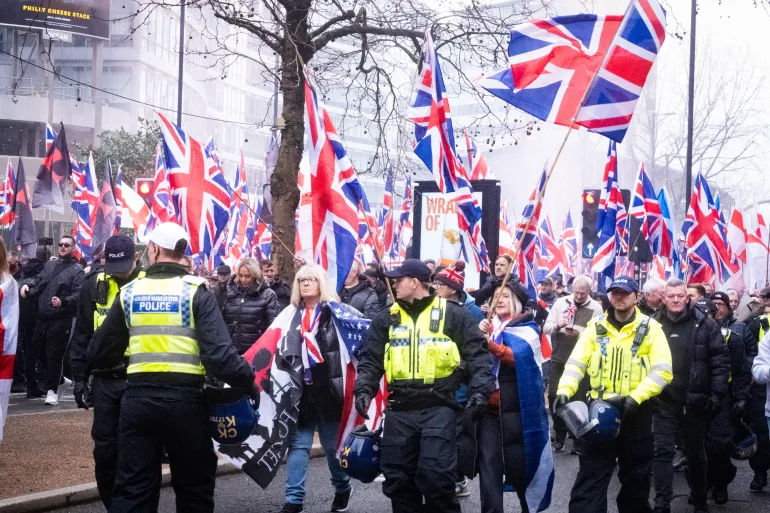
Hundreds of demonstrators waving Union Jack flags marched through Manchester city centre on February 21, chanting anti-immigration slogans and targeting political leaders. The Manchester anti-Islam march quickly became a flashpoint for wider debates about race, migration, and freedom of assembly in the United Kingdom.
Police formed tight cordons to keep the two sides apart, but tensions escalated throughout the afternoon, with shouting, scuffles, and emotional confrontations unfolding in front of bystanders.
Background of the Manchester Anti-Islam March
The Manchester anti-Islam march was organised by Britain First, a far-right political party known for its calls for mass deportations and its opposition to Islam and immigration.
Led by party figure Paul Golding, the group marched through the city centre under heavy police escort. Supporters chanted “send them back” and voiced anger over what they described as government failures on immigration.
Many participants appeared to be livestreaming the march to online audiences, reflecting how digital platforms have amplified far-right mobilisation in recent years.
The march was permitted under UK law, which protects freedom of assembly. However, critics argued that allowing the Manchester anti-Islam march to proceed legitimised extremist rhetoric.
Counterprotesters Outnumber Far-Right Demonstrators
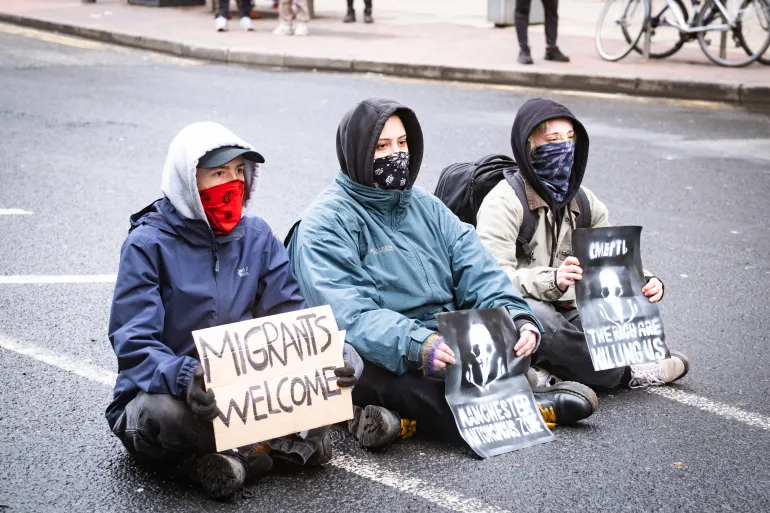
In response, antifascist groups organised a counterprotest that drew a much larger crowd. Demonstrators carried antiracist banners, Palestinian flags, and placards denouncing racism and fascism.
Many counterprotesters travelled long distances to attend. Some said they felt compelled to show solidarity with migrants and minority communities who they believe are increasingly targeted by hostile rhetoric.
One protester described attending as a “no-brainer,” citing family members from the Windrush generation who faced racism when they first arrived in Britain decades ago.
The emotional weight of history was evident. Several younger demonstrators said their families had experienced renewed racial hostility in recent years, echoing fears of a regression in social cohesion.
Clashes and Police Intervention During the Manchester Anti-Islam March
As the two groups converged, the atmosphere intensified. The Manchester anti-Islam march met its counterprotesters in what observers described as an expletive-filled crescendo.
Some Britain First supporters allegedly used flag poles to prod counterprotesters. A small group staged a sit-down protest in front of the march and had to be escorted away by riot police for their safety.
Police struggled to maintain separation lines as demonstrators attempted to breach barriers. Officers later said the operation required extensive planning due to multiple events taking place in Manchester that weekend, including football fixtures and other rallies.
Despite visible tension, major large-scale violence was avoided. However, the confrontations highlighted the deep divisions surrounding immigration and identity politics in the UK.
Broader Political Context in the United Kingdom
The Manchester anti-Islam march unfolded amid ongoing national debates about immigration policy, asylum procedures, and multiculturalism.
Prime Minister Keir Starmer has faced criticism from both the political right and left regarding immigration enforcement and border control. Far-right groups argue that the government has failed to curb irregular migration, while progressive activists warn against rhetoric that stigmatizes entire communities.
In recent years, the UK has seen periodic surges in far-right activism, often linked to economic anxieties and social change. Analysts say such marches are designed not only to mobilise supporters but also to generate viral content and provoke confrontation.
At the same time, counterprotests have become increasingly organised, reflecting strong resistance from civil society groups, trade unions, and student organisations.
Community Voices and Minority Concerns
Several counterprotesters expressed frustration with police for allowing the Manchester anti-Islam march to proceed.
Some Jewish and anti-racist activists argued that far-right groups use public demonstrations to spread “divisive, racist positions.” Others said police resources could be better spent addressing community safety rather than facilitating extremist rallies.
Minority communities have voiced concern that anti-Islam rhetoric fosters hostility toward Muslims and immigrants more broadly.
Community leaders have repeatedly emphasised that public debate on immigration must not cross into incitement or dehumanisation.
Freedom of Assembly vs Public Safety
The Manchester anti-Islam march raises complex legal and ethical questions. In the UK, the right to peaceful protest is protected, even for controversial groups.
Authorities must balance that right with public safety and community cohesion. Banning demonstrations outright risks legal challenges and accusations of political bias.
Police officials described the day as particularly challenging, given shifting routes and overlapping public events. Critics, however, argue that repeated far-right demonstrations place disproportionate strain on public resources.
The debate is unlikely to subside. As online radicalisation and polarised political discourse intensify, cities like Manchester may continue to experience flashpoints like this one.
Social Media and Escalation
Livestreaming and viral clips played a visible role in the Manchester anti-Islam march.
Participants from both sides recorded confrontations, amplifying tensions beyond the city centre. Analysts note that such exposure can both mobilise supporters and deepen polarisation.
The digital dimension of modern protests means that local events quickly become national or even global narratives.
What Happens Next?
While the immediate standoff concluded without widespread violence, underlying tensions remain.
Community groups are calling for dialogue and investment in anti-racism initiatives. Far-right groups, meanwhile, continue to schedule rallies across the country.
The Manchester anti-Islam march is unlikely to be the last confrontation of its kind. As Britain grapples with questions about identity, migration, and economic inequality, such public clashes may become more frequent.
Observers warn that political leadership will be critical in determining whether divisions deepen or pathways toward reconciliation emerge.
This report is part of broader UK political and social coverage on FFRNEWS, including developments in national policy debates covered in our Politics section. For more breaking global updates, visit the FFRNEWS homepage. Details in this article are based on reporting by Al Jazeera, which covered events on the ground in Manchester.