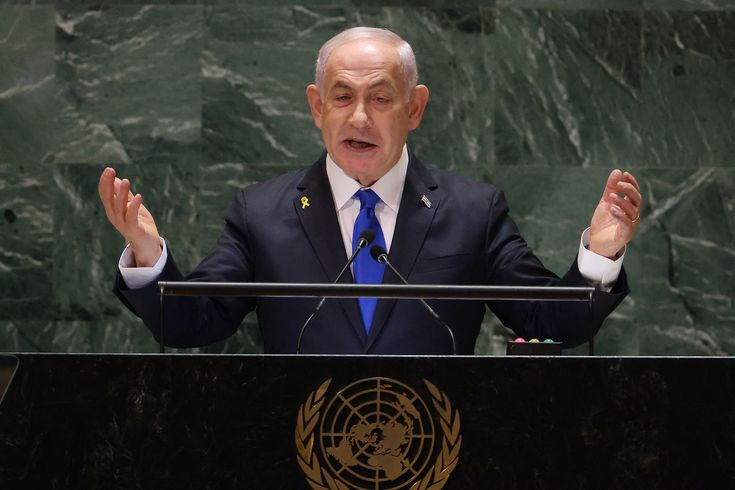
Netanyahu UN speech at the United Nations General Assembly in New York triggered both global headlines and diplomatic drama. Israeli Prime Minister Benjamin Netanyahu fiercely condemned the recognition of a Palestinian state by several Western nations, calling it a “mark of shame” and warning it sent the dangerous message that “murdering Jews pays off.” His combative remarks were met with a wave of walkouts by diplomats and officials, leaving large sections of the assembly hall empty. Outside, protesters filled Times Square, echoing growing anger against Israel’s war in Gaza.
The moment highlighted Israel’s deepening isolation on the international stage. With countries such as the United Kingdom, France, Canada, and Australia formally recognizing a Palestinian state in recent days, the symbolic blow to Israeli diplomacy came at one of the world’s most important forums. Netanyahu’s speech underscored his determination to reject any Palestinian sovereignty, but it also exposed how sharply global and domestic opinion is turning against his government.
The recognition of Palestine and Netanyahu’s fury
The timing of the speech was crucial. In just a week, multiple Western allies of Israel — including European heavyweights like the UK and France — formally recognized a Palestinian state. While mostly symbolic in immediate terms, the recognition carries heavy political and diplomatic weight. Netanyahu branded the moves “a mark of shame” during his UN address, saying they embolden violent groups such as Hamas by showing that bloodshed brings rewards.
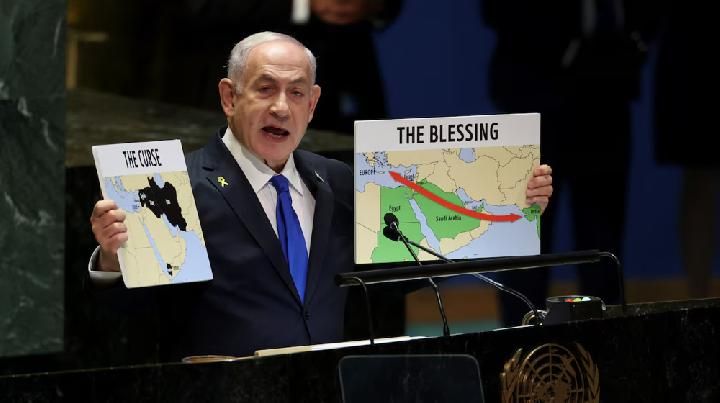
Holding up a map labeled “The Curse”, Netanyahu claimed it depicted a web of Iranian proxy groups — Hezbollah in Lebanon, the Houthis in Yemen, Hamas in Gaza, and Iran itself. By presenting this imagery at the UN, Netanyahu attempted to frame Israel not just as a nation under attack but as a frontline defender in a broader regional war against Iranian influence.
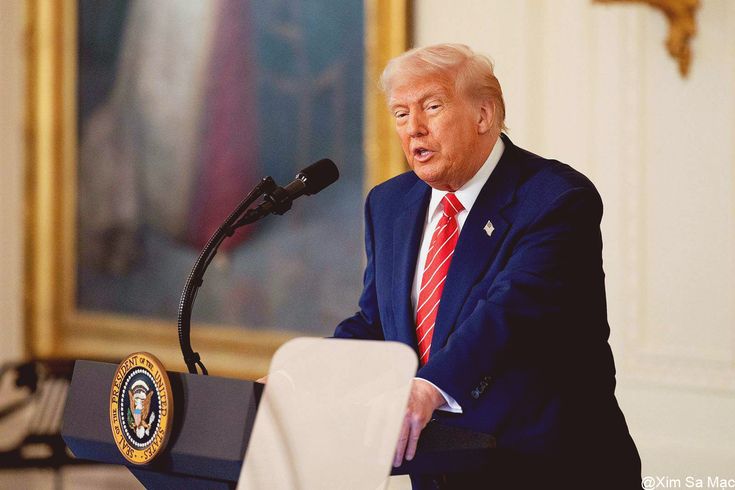
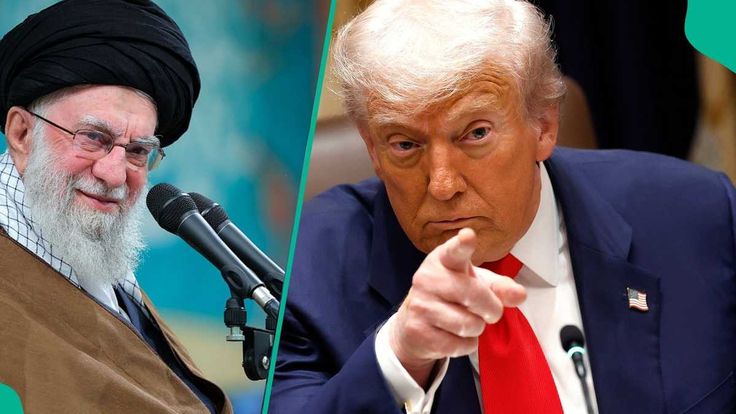
He went further, drawing parallels between Hamas’s 7 October 2023 attack on Israel and the September 11 terrorist attacks in the United States, reinforcing his message that Israel and America face the same enemies. His praise for U.S. President Donald Trump’s involvement in bombing Iran’s Fordo nuclear site earlier this year drew applause from some allies but also raised concerns about escalating regional conflict.
Walkouts and visible backlash
As Netanyahu launched into his sharp rhetoric, dozens of diplomats staged a coordinated walkout, leaving empty chairs scattered throughout the hall. The optics were striking: a global rejection of his narrative in real time.
Meanwhile, protesters in New York — particularly in Times Square — voiced opposition to Israel’s military campaign in Gaza. Their presence served as a reminder that Netanyahu’s words resonate far beyond UN walls, touching off debates across streets, communities, and capitals worldwide.
The walkouts were not just symbolic; they underscored a profound rift between Israel and some of its traditional allies. Recognition of Palestine, long resisted by Washington and European powers, now reflects a shift in international patience with Israel’s continued occupation and military strategies.
Denials on Gaza genocide and aid blockade
Netanyahu used his platform to push back strongly against international accusations. He dismissed the UN commission of inquiry’s finding that Israel had committed genocide in Gaza, calling the charge “baseless.” He also rejected repeated claims from UN agencies that Israel was deliberately restricting humanitarian aid to Gaza, despite reports of famine confirmed by a UN-backed body in August.
His rebuttals came as Gaza’s suffering remains front-page news: at least 65,000 people killed in Israeli strikes since October 2023, according to the territory’s health ministry. International journalists remain largely barred from independent access, making external verification challenging, but controlled reporting has shown the devastation firsthand.
Propaganda or reassurance? Netanyahu’s Gaza broadcast
Perhaps the most controversial element of his UN performance came when Netanyahu announced that Israeli military trucks had been fitted with loudspeakers to broadcast his speech into Gaza. He also claimed Israeli intelligence hacked smartphones in Gaza to stream his words directly to residents — though Gaza-based sources denied this happened.
Reading a message directly to hostages still held in Gaza, Netanyahu declared: “We have not forgotten you, not even for a second. The people of Israel are with you. We will not falter until we bring you home.”
While intended as reassurance, critics slammed the act as tone-deaf and humiliating for civilians trapped in desperate conditions. Gaza resident Fadi told the BBC: “What does he gain by broadcasting his speech forcibly to besieged civilians inside tents, except to further humiliate them?”
Internal backlash in Israel
The fallout wasn’t limited to the international stage. Netanyahu quickly faced criticism at home, with opposition leaders accusing him of gimmickry and weakness.
- Yair Lapid, opposition leader, described the performance as “a weary and whining speech overloaded with overused gimmicks,” adding that Netanyahu worsened Israel’s diplomatic standing rather than protecting it.
- Yair Golan, leader of Israel’s Democrats party, called the speech “invalid, childish, and insane,” blasting the loudspeaker stunt as propaganda.
For critics, the prime minister appeared disconnected from the hostages’ suffering, overly reliant on theatrics, and blind to Israel’s worsening international isolation.
A contrasting voice: Abbas’s offer
Just a day earlier, Palestinian Authority leader Mahmoud Abbas struck a very different tone. In his address to the UN, Abbas declared his readiness to work with world leaders to implement a peace plan for Israel and Palestine. The contrast between Abbas’s conciliatory language and Netanyahu’s combative posture highlights the gulf in strategy — one leaning on diplomacy, the other on defiance.
Trump hints at a Gaza deal
Adding intrigue, former U.S. President Donald Trump told journalists shortly after Netanyahu’s speech: “I think we have a deal on Gaza.” Though vague on details, his remark fueled speculation that a ceasefire might be closer than previously thought.
If accurate, it would mean Netanyahu’s aggressive UN stance was delivered on the very cusp of a diplomatic breakthrough — a contradiction that would further inflame critics who accuse him of prioritizing political theater over genuine solutions.
Global implications of the Netanyahu UN speech
The Netanyahu UN speech crystallizes several broader dynamics:
- Israel’s growing isolation — Walkouts and Western recognition of Palestine suggest a diplomatic tide turning sharply against Netanyahu’s policies.
- Domestic fragility — Mounting opposition criticism hints at political cracks within Israel, even as war continues.
- Shifting global narratives — Palestinian recognition, combined with humanitarian concerns in Gaza, is reframing international debates about justice, accountability, and sovereignty.
- Propaganda risks — Attempts to broadcast directly into Gaza may backfire, reinforcing perceptions of heavy-handedness rather than strength.
- Trump’s unpredictable role — His reference to a Gaza deal adds uncertainty and shows how U.S. politics intertwine with Israel’s trajectory.
Source: BBC News