
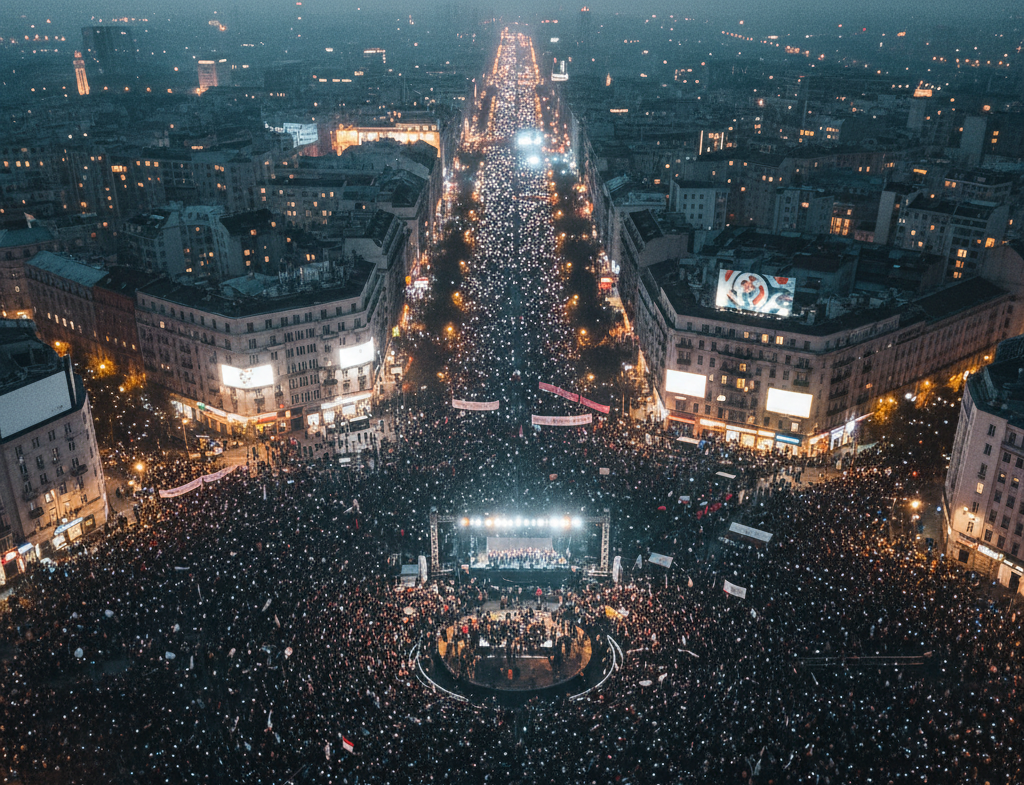
The streets of Novi Sad were filled with grief and fury as tens of thousands of Serbians marked the Serbia train station collapse anniversary — a tragedy that left 16 people dead and has since evolved into one of the largest antigovernment movements in recent Serbian history. At precisely 11:52 a.m. local time, the crowd fell into a haunting 16 minutes of silence to honor each life lost in the disaster that struck exactly a year ago, on November 1, 2024.
The silence was followed by chants of “Justice for the Sixteen” and “No More Corruption,” echoing through the heart of the city. Mourners held candles, banners, and photos of their loved ones, transforming the railway station — once a symbol of progress — into a memorial of national failure. The mood was solemn yet defiant, as families, students, and activists demanded transparency, accountability, and long-delayed trials.
Al Jazeera correspondent Milena Veselinovic, reporting from the scene, described the atmosphere as “incredibly sombre,” saying that “you could hear a pin drop” during the silent tribute. She added, “The protesters’ goal was not only to remember the victims but to demand that justice finally be served. A year on, no one has been tried, and the frustration among citizens is palpable.”
A Year of Pain, and Still No Justice
The Serbia train station collapse in Novi Sad occurred during the grand reopening of the newly renovated structure, which was intended to symbolize modernization and progress. Instead, it exposed systemic corruption, construction negligence, and political manipulation. Thirteen individuals, including former construction minister Goran Vesic, were charged with criminal negligence and misuse of funds — yet none have been tried to date.
“The charges still haven’t been confirmed by a higher court,” Veselinovic reported. “People here have little faith in the system. They believe this delay is intentional — a tactic to protect those in power.”
This sense of impunity has only deepened public distrust. Many Serbians see the collapse not as an isolated accident, but as a tragic symptom of a corrupt system where infrastructure projects are exploited for profit, corners are cut, and lives are lost as a result.
A Nation United in Anger
From students to pensioners, people from all over Serbia poured into Novi Sad to join the anniversary protest. Organizers described it as “the largest commemorative gathering in modern Serbian history.” Marchers traveled from as far as Belgrade and Novi Pazar — some walking over 100 kilometers in honor of the victims.
The student-led movement that arose after the tragedy has become a beacon of hope for many disillusioned Serbians. It has inspired waves of demonstrations across the country, calling for judicial reform, an end to state corruption, and early elections.
“What we are witnessing is not just grief — it’s a rebellion against injustice,” said one protest organizer. “We have lost faith in the promises of accountability. The system protects the guilty and punishes the voiceless.”
Voices of the Bereaved
Among the attendees was Dijana Hrka, whose 27-year-old son perished in the collapse. Holding a framed photo of him, she spoke to Al Jazeera through tears. “What I want to know is who killed my child so I can have a little peace,” she said. “I am looking for justice. I don’t want any other mother to go through what I am going through.”
Her anguish mirrors the collective pain of families still waiting for closure. Many have expressed anger at what they call “state silence” — the government’s failure to deliver justice or meaningful support to those affected.
Political Shockwaves
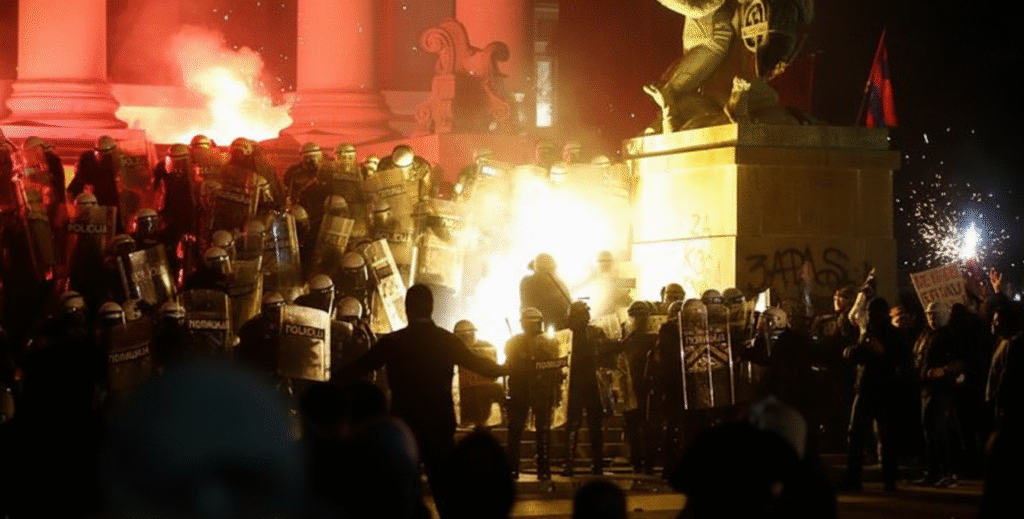
The Serbia train station collapse has had far-reaching political consequences. The sustained protests it inspired led to the resignation of the prime minister and the fall of his government earlier this year. However, President Aleksandar Vucic has remained defiant, rejecting all accusations of wrongdoing.
Vucic has frequently dismissed protesters as “foreign-funded agitators” and “traitors,” accusing Western powers of trying to destabilize Serbia. Yet public anger continues to mount, fueled by widespread perceptions of corruption and authoritarianism.
In a rare conciliatory move, Vucic addressed the nation the day before the anniversary, offering an apology. “This applies both to students and to protesters, as well as to others with whom I disagreed. I apologise for that,” he said, calling for dialogue. But many Serbians dismissed his words as political theatre.
“Sky-High” Corruption
Serbian political analyst Aleksandar Popov described corruption in Serbia as “sky-high,” telling Al Jazeera that billions of euros are lost to mismanagement in large-scale infrastructure projects. “The government and the president have captured all key state institutions, including the judiciary,” Popov said. “Until that changes, justice will remain out of reach.”
A European Union–backed investigation is ongoing, probing the misuse of EU development funds in the Novi Sad railway project. Simultaneously, Serbia’s internal anticorruption agency has launched a separate inquiry — though progress has been slow.
A City Still in Ruins
The physical and emotional scars of the Serbia train station collapse remain. Local officials estimate that over 90% of the surrounding area suffered some level of damage from the disaster, with nearby homes, hospitals, and even fire stations affected.
Mayor Richard Solomon of Novi Sad described the situation as “a delicate balance” — understanding the desperation of looters in the days after the collapse but condemning lawlessness. “Persons are seizing the opportunity to pick up what they can off the ground, but others have been more forceful, breaking into properties,” he said.
The Fight for the Future
As the evening drew in, students released 16 white doves into the air — one for each victim — while the crowd sang folk songs of mourning. Many wore shirts emblazoned with the slogan, “We remember, and we demand justice.”
For many, the Serbia train station collapse has become more than a national tragedy; it is a symbol of a broken system — one where the people’s patience has run out.
As one elderly protester told reporters: “We are not just here for the dead. We are here for the living. We want a Serbia where our children don’t die under corrupt roofs.”
The movement shows no signs of fading. What began as mourning has evolved into a call for a better Serbia — one built not on corruption, but on accountability, transparency, and hope.
Source:
Al Jazeera FFR Politics