
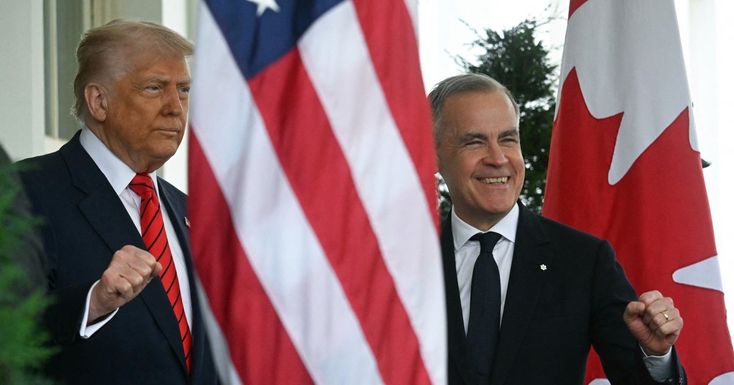
Trump Canada trade talks have taken a dramatic turn as U.S. President Donald Trump announced an immediate end to negotiations with Canada. The decision came after a controversial advert from Ontario criticized the U.S. tariffs currently impacting Canadian industries. Trump blasted the video as “FAKE” and “egregious,” declaring the trade talks “HEREBY TERMINATED.”
U.S. President Donald Trump has abruptly ended all trade negotiations with Canada, citing an advertisement produced by Ontario’s provincial government that criticised U.S. tariffs. The move came after a minute-long video, featuring an excerpt from Ronald Reagan’s 1987 address on trade, declared tariffs harmful to Americans. Trump took to social media, calling the spot “FAKE” and “egregious,” and announced: “Trade talks with Canada are HEREBY TERMINATED.”
What Sparked the Break-Off?
The advert, created by the Canadian province of Ontario, quoted Reagan:
“When someone says ‘let’s impose tariffs on foreign imports’… over the long run, such trade barriers hurt every American, worker and consumer.”
While the quote is genuine, the Ronald Reagan Foundation said the spot used “selective” edits and accused Ontario of using Reagan’s voice and likeness without permission.
In response, Trump said the video interfered with U.S. Supreme Court deliberations on the legality of his tariffs and justified ending trade talks imminently.
The Tariffs at Issue
Trump’s administration has imposed a 35% levy on many Canadian imports, including metals and automobiles. Ontario, Canada’s largest province by population and economy, has been especially hard‐hit. Additional U.S. tariffs include a 50% metal levy and 25% automobile duties under sector-specific measures.
Although those tariffs pre-dated the advertisement, the campaign intensified tensions: Ontario invested roughly CAD $75 million (~£40 million; ~$54 million) in the video campaign across U.S. TV channels. Ontario Premier Doug Ford described U.S. tariffs as pulling a knife and yanking it in, and even threatened to cut off power exports to the U.S.
Canada’s Response
So far, neither Canadian Prime Minister Mark Carney nor Premier Ford has responded publicly to Trump’s announcement. Carney had earlier sought to negotiate a deal easing U.S. tariffs.
Observers say this is the second time Trump has ended trade talks with Ottawa — the previous occasion followed Canada’s plan to impose a digital services tax on U.S. tech firms, a move later rescinded.
Legal and Political Implications
Trump’s decision could have far-reaching impacts. The U.S. Supreme Court is expected to rule on whether his sweeping tariffs are legal — possibly requiring Washington to refund billions collected. Trump said the advert played a role in his timing.
The Reagan Foundation’s review of legal options frames the dispute as more than trade policy — it now involves intellectual property, likeness rights, and international ad campaigns directed at U.S. audiences.

Economic Stakes
Canada remains one of the U.S.’s largest trading partners. The targeted tariffs have already led to job losses in Ontario, particularly in the auto and steel sectors. Canada exports billions of dollars worth of goods to the U.S. annually, and any disruption could have ripple effects across supply chains on both sides of the border.
India, one of Russia’s major oil clients, has been reported to consider cutting back purchases in response to U.S. pressure — a parallel illustration of how global trade can pivot quickly in response to contentious policy moves.
The Bigger Picture
Trump’s abrupt termination of trade talks with Canada over a single advertisement signals a shift in how trade diplomacy may be conducted — less anchored in quiet negotiation and more reactive to media and political signals. It also underscores the power of public messaging: the advert targeted U.S. audiences and framed Canadian exports as a threat to American workers.
Whether Canada will respond in kind, seek redress in international trade forums, or pursue other diplomatic options remains uncertain. But for now, the longstanding trade relationship between the two nations has entered a very public and adversarial phase.
Source: BBC