Updated by FFRNews on November 8, 2025
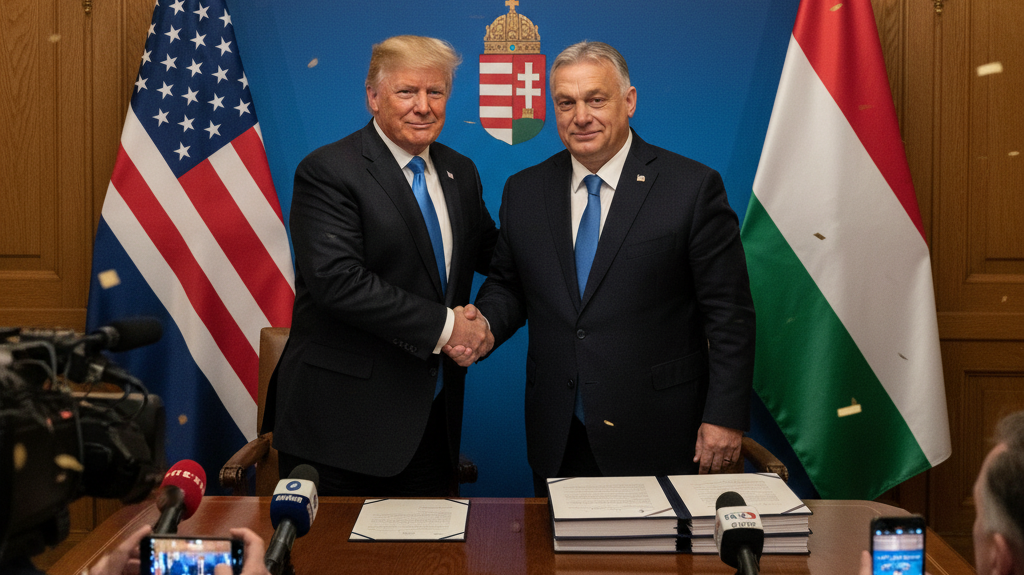
The Trump Hungary Sanctions Exemption has made global headlines as US President Donald Trump granted Hungary a one-year waiver from sanctions related to purchasing Russian oil and gas. The decision, announced after Hungarian Prime Minister Viktor Orban’s visit to the White House, underscores a growing divide between the United States, the European Union, and their policies toward Russia amid the ongoing Ukraine war.
Trump’s Strategic Move and Orban’s Energy Lifeline
The White House confirmed that Hungary received a temporary sanctions exemption that allows the country to continue importing energy from Russian companies — a major diplomatic win for Orban, who has maintained close relations with Moscow despite Western pressure.
During the meeting, Trump defended the decision, citing Hungary’s geographical disadvantage as a landlocked nation dependent on Russian pipelines.
“It’s very difficult for him [Orban] to get oil and gas from other areas,” Trump said.
Hungarian Foreign Minister Péter Szijjártó later posted on X (formerly Twitter) that the US had granted a “full and unlimited exemption.” However, a senior US official clarified that it was limited to one year and subject to review.
A Diplomatic Win for Viktor Orban
For Orban, the Trump Hungary Sanctions Exemption marks a significant political and economic victory. The Hungarian leader had warned that strict sanctions would devastate his nation’s already fragile economy, heavily reliant on Russian energy.
This exemption provides short-term relief, giving Hungary the ability to stabilize its fuel imports and energy pricing as the country approaches national elections next spring.
Orban has framed his stance as pragmatic rather than political, emphasizing Hungary’s need for reliable energy sources.
“Pipelines are not ideological or political — they are physical realities,” Orban said in a joint press statement.
Trump’s Balancing Act Between Energy and Diplomacy
President Trump’s decision appears to contrast with his earlier tough stance on penalizing nations that purchase energy from Russia. However, as part of this new arrangement, Hungary agreed to buy several hundred million dollars’ worth of US natural gas, signaling an attempt by Washington to balance economic realism with political strategy.
Experts believe this deal aims to strengthen US-Hungary ties while simultaneously reducing the long-term grip of Russian energy dependency in Central Europe.
European Reaction: Divided and Uneasy
The European Union has reacted cautiously to the news. Several EU leaders have criticized Hungary’s continued engagement with Russia, arguing that the exemption undermines EU unity and weakens collective pressure on Moscow.
Despite this, Trump defended Orban’s leadership, urging European allies to “respect this leader very, very strongly because he’s been right on immigration.”
Observers note that the Trump Hungary Sanctions Exemption may spark tension within NATO and the EU, where some leaders see the move as politically motivated and potentially destabilizing for the region’s stance against Russia.
Ukraine War and Hopes for Peace Talks
Beyond energy, the White House meeting also touched on the Ukraine conflict, where both Trump and Orban expressed skepticism about a military victory for Kyiv.
“He understands Putin and knows him very well,” Trump said. “Viktor feels we’re going to get that war ended in the not-too-distant future.”
Orban echoed the sentiment, asserting that only the US and Hungary genuinely want peace, while “others believe Ukraine can win on the front line, which is a misunderstanding of the situation.”
Analysts suggest that the meeting signals Trump’s openness to new peace negotiations with Russia, though the prospect remains uncertain given tensions across Europe.
Economic Implications for Hungary
Hungary’s export-driven economy has faced challenges from both EU trade restrictions and Trump’s tariffs on European goods, which have hurt its manufacturing and car industries. The Trump Hungary Sanctions Exemption could therefore act as a temporary cushion, helping the Hungarian economy maintain stability through affordable energy access.
Still, critics warn that the exemption only delays Hungary’s inevitable need to diversify its energy sources. If the waiver is not renewed next year, the country could once again face rising energy prices and political backlash.
Global Reactions and Long-Term Outlook
International analysts are split on the long-term impact of the Trump Hungary Sanctions Exemption. Supporters argue that it represents pragmatic diplomacy in addressing the energy realities of landlocked nations. Detractors claim it undermines Western unity against Moscow’s aggression.
Either way, the move has thrust Hungary and its populist leader into the center of a geopolitical balancing act between Washington, Brussels, and Moscow.
If renewed beyond one year, the waiver could signal a shift in global energy policy under Trump’s administration — one prioritizing national interest and bilateral loyalty over collective European strategies.
Conclusion
The Trump Hungary Sanctions Exemption underscores the complex intersection of politics, energy, and diplomacy in a rapidly shifting world order. For Hungary, it’s a short-term victory that reinforces Orban’s narrative of independence and resilience. For Trump, it’s another demonstration of transactional politics — rewarding loyalty while reshaping alliances.
As the energy and security dynamics in Europe continue to evolve, this exemption could either pave the way for closer US-Hungary cooperation or deepen rifts within the Western alliance.
For further coverage on global politics and US foreign relations, visit FFRNews Politics or follow the full report on BBC.