
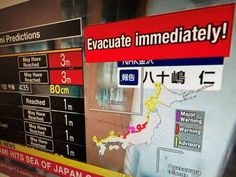
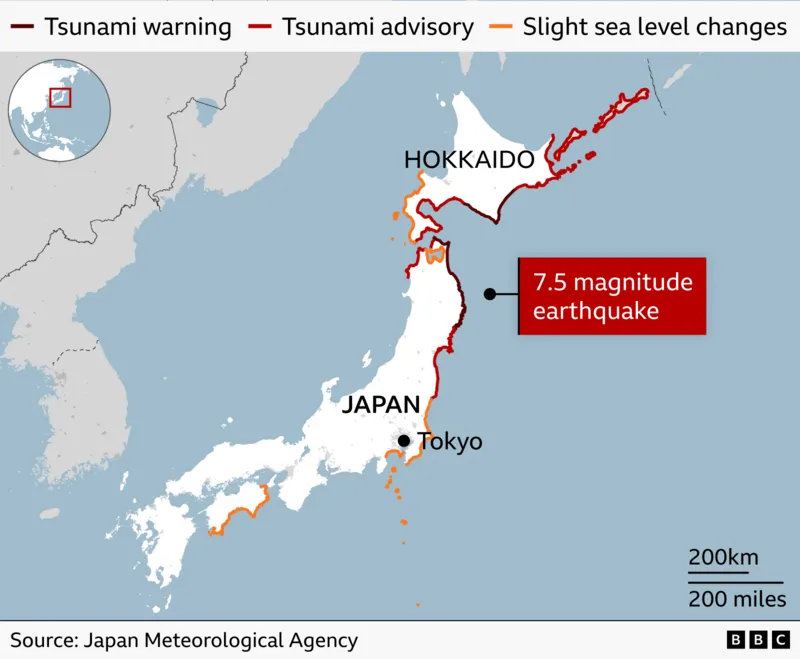
A major Japan quake alert has been issued after a powerful 7.7 magnitude earthquake struck off the northeastern coast of Japan, prompting tsunami warnings and widespread evacuations. The quake, recorded at a shallow depth of 10 kilometers, hit waters near Iwate Prefecture, about 530 kilometers north of Tokyo.
Authorities quickly responded by issuing evacuation orders for thousands of residents living in coastal areas, urging them to move to higher ground amid fears of incoming tsunami waves. Initial warnings suggested waves could reach up to three meters, although the highest recorded wave measured around 80 centimeters. Despite this, officials stressed that the خطر is far from over, warning that stronger seismic activity could follow.
Rising Risk of a Bigger Earthquake in Coming Days
Japan’s Meteorological Agency has raised serious concerns following the quake, stating that the likelihood of a much larger earthquake—potentially exceeding magnitude 8.0—is now higher than usual. This elevated Japan quake alert has placed the entire region on edge, with authorities emphasizing that aftershocks or a secondary major quake could occur within the next week.
The warning reflects Japan’s deep understanding of seismic patterns, particularly in regions along tectonic boundaries. Experts caution that undersea earthquakes like this one can sometimes precede even more powerful events, making preparedness and vigilance critical in the days ahead.
Residents across affected areas, including Hokkaido and parts of Honshu, have been advised to remain alert, even after initial tsunami warnings were downgraded and eventually lifted.
Tsunami Warnings Spark Evacuations and Disruptions
The Japan quake alert led to immediate tsunami warnings along parts of the country’s eastern coastline. Emergency systems broadcast alerts across television, radio, and public loudspeakers, urging people to evacuate coastal and riverside مناطق without delay.
Public response was swift. Residents reported evacuating buildings and moving to designated safe zones as authorities emphasized that tsunami waves can arrive in multiple surges. Officials warned that even smaller waves can pose significant خطر due to strong currents and flooding.
Transport systems were also impacted. Several bullet train services were temporarily halted, and power outages affected around 100 homes. While no major casualties or large-scale destruction were immediately reported, authorities remained cautious, stressing that the situation could evolve rapidly.
Memories of the 2011 Disaster Resurface
The latest Japan quake alert has revived painful memories of the devastating 2011 Tōhoku Earthquake and Tsunami, one of the deadliest natural disasters in modern history. That catastrophe claimed more than 18,000 lives and triggered the Fukushima nuclear disaster, leaving a lasting impact on the nation.
For many residents, the current warnings serve as a stark reminder of how quickly a natural event can escalate into a national tragedy. The psychological impact of past disasters continues to shape public response, with people taking evacuation orders seriously and prioritizing safety.
Government officials have acknowledged this حساس context, urging calm while reinforcing the importance of preparedness. Prime Minister Sanae Takaichi called on citizens to move to “higher, safer places” and to follow official guidance closely.
Japan’s Vulnerability Along the Ring of Fire
Japan’s geographic position along the Ring of Fire makes it one of the most earthquake-prone countries in the world. The nation experiences approximately 1,500 earthquakes each year and accounts for about 10% of the world’s strongest quakes.
This constant seismic activity has led Japan to develop some of the most advanced early warning systems and disaster preparedness measures globally. Buildings are designed to withstand strong tremors, and nationwide alert systems ensure rapid communication during emergencies.
Despite these advancements, the unpredictable nature of earthquakes means that risks can never be fully eliminated. The current Japan quake alert highlights the ongoing challenge of balancing preparedness with the inherent uncertainty of natural disasters.
Authorities Urge Continued Vigilance
Even as tsunami warnings have been lifted, officials continue to stress that the situation remains fluid. The Japan quake alert is still in effect, with authorities urging residents to stay informed and prepared for potential aftershocks or a larger quake.
Emergency services remain on standby, and monitoring systems are closely tracking seismic activity in the region. Experts emphasize that the next few days will be critical in determining whether the initial quake was an isolated event or part of a larger سلسلة of seismic activity.
The government has also reassured the public that infrastructure and nuclear facilities are being closely monitored to prevent any secondary crises. Transparency and timely updates remain key priorities as officials work to maintain public trust and safety.
Global Attention on Japan’s Situation
The Japan quake alert has drawn international attention, with governments and organizations monitoring developments closely. Natural disasters of this scale often have global implications, particularly in a country as economically significant as Japan.
As the world watches, the situation serves as a reminder of the أهمية of disaster preparedness and international cooperation in responding to emergencies. The lessons learned from Japan’s response could prove valuable for other nations facing similar risks.
With uncertainty still looming, the focus remains on safety, preparedness, and resilience as Japan navigates yet another اختبار of its ability to مواجهة natural disasters.
For more, please check out FFRNEWS.